
| Document/Purpose | Defines the operational concept of the IOR mission including mission context, actors, operational contexts, system actors, their interactions, and OPCON stages. |
| Traceability (Upstream /Downstream) Documents | Upstream: Mission Context, Stakeholder Requirements Downstream: Mission Requirements (note), System Requirements |
| Status | DRAFT |
| Baseline Version/Date | Current Version | Not yet established | v0.1 |
| Last Updated | |
| Owner / Lead | Sanjay Chadha |
| Contributors | |
| Reviewers | |
| Scope/Out-Of-Scope | Scope: Operational Analysis (Mission Context, Operational Context), CONOPS stages Out-of-Scope: System Analysis, system design, system architecture |
Table of Contents
- Mission Context
- System Boundaries and Assumptions
- Operational Entities
- Operational Context Diagrams
- Operational Capabilities
- Terms Used
- OpCon – Cross-Cutting Operational Safety Policies
- IOR Lifecycle Stages
- IOR Operations – 3 sub-stages
- Operations CONOPS: Propellant Supply and Return
- Scenario
- Stage Description, Control Authority, and Operational Notes
- State Description
- Propellant Delivery Mission Planning
- Operations CONOPS: Propellant Transfer
- Detailed OPCON: IOR Initial Deployment
- OpCon Stage: Pre-Launch IOR: Launch Planning & Preparation
- Input:
- Trigger:
- Key activities:
- Key constraints:
- Exit condition:
- Major risks or failure branches:
- OpCon Stage: Launch and Orbit Insertion
- Trigger:
- Key activities:
- Key constraints:
- Exit condition:
- Major risks or failure branches:
- Detailed OPCON: IOR Client Servicing
- OpCon Stage: Nominal standby state
- Trigger:
- Inputs (from):
- Key activities:
- Output (to):
- Key constraints:
- Exit condition:
- Major risks or failure branches:
- OpCon Stage: Client request and planning
- Key activities:
- Key constraints:
- Output (to):
- Exit condition (what ends it):
- Major risks or failure branches:
- OpCon Stage: Rendezvous
- Input (from):
- Key activities:
- Key constraints:
- Output (to):
- Exit condition:
- Major risks or failure branches:
- OpCon Stage: Proximity operations
- Input (from):
- Trigger:
- Key activities:
- Key constraints:
- Output (to):
- Exit condition:
- Major risks or failure branches:
- Nominal IOR Servicing Mission Flow
- Operational Scenarios
- Operational Scenario: Nominal Service Scenario
- Operational Scenario: Phasing Stage
- Operational Scenario: Nominal Proximity Operations
- Operational Scenario: Failure Scenario: Proximity Abort / Retreat
- Operational Scenario: Nominal Return to Depot
Mission Context
This ConOps assumes Mission Context 1 – LEO with Interface-Enabled Client Spacecraft defined in Section 1.1.1 Mission Context.
Key parameters used in this ConOps:
- Orbit regime: LEO
- Target customer: LEO constellation operator
- Refueling architecture: Depot + Shuttle
- Propellant family: Electric propulsion
- Service spacecraft: IOR Enabled client (i.e. passive with compliant physical interface
- Frequency of service is constrained by mission execution time and propellant logistics.
System Boundaries and Assumptions
- IOR provides propellant delivery in LEO to cooperative clients
- CS is cooperative and has compliant refueling interface
- Electric propellant only
- Approach corridors, safety distances, keep-out zones are applicable
- Depot resupply from Earth exists (it is out-of-scope in phase 1)
IOR operational scope: Includes Depot, Service Vehicle roles
Out of scope: Ground Segment, Client Spacecraft, Launch Vehicle, Space Environment
Operational Entities
- Launch Vehicle (LV)
- Depot (D)
- Service Vehicle (SV)
- Client Spacecraft (CS)
- Client Operator – Client is involved in the delivery process
- Ground Segment – Provides mission planning, command, and monitoring functions for IOR operations and client coordination
- Space Traffic Management
- Space Environment – includes orbital dynamics, drag, gravity, debris, sun, radiation, thermal effects, temperature,
Operational Context Diagrams
OCD Main Mission
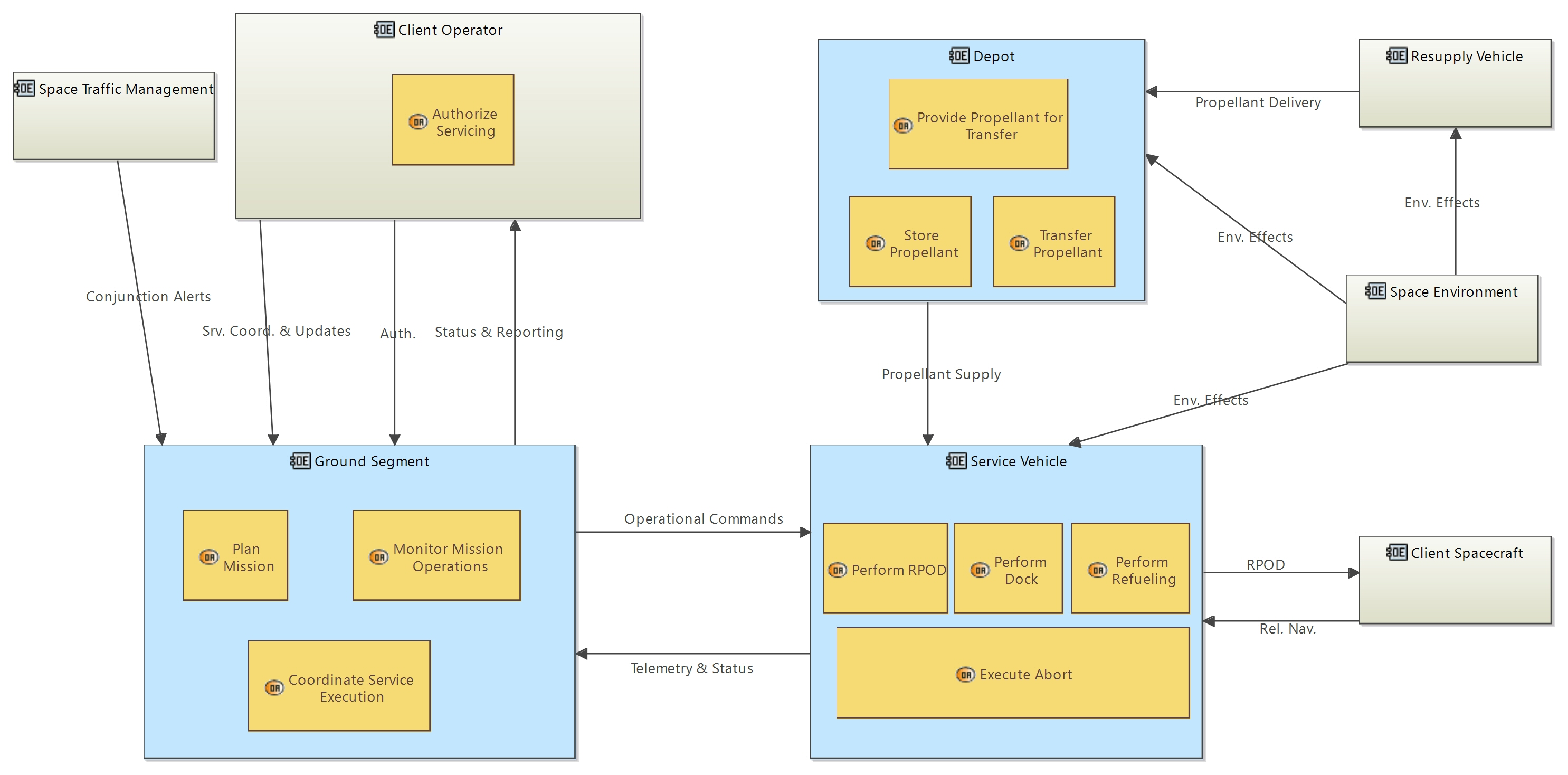
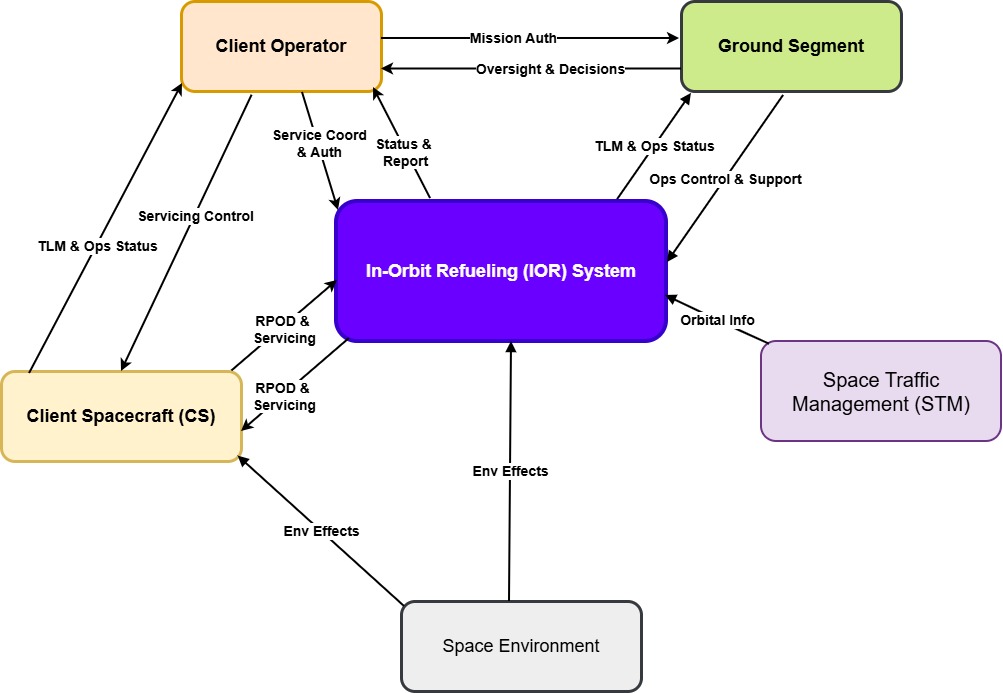
Operational Interactions
Some Assumptions:
IOR Mission = Depot + Service Vehicle
| From Entity A | To Entity B | Interaction | Detailed Interactions | Interaction Nature |
|---|---|---|---|---|
| Client Operator | IOR Mission | Service Coordination and Mission Authorization
|
|
Information |
| IOR Mission | Client Operator | Mission Status & Reporting |
|
Information |
| Ground Segment | IOR Mission | Operational Control & Mission Support |
|
Information |
| IOR Mission | Ground Segment | Telemetry & Operational Status |
|
Information |
| Client Operator | Ground Segment | Mission Authority & Coordination |
|
Information |
| Ground Segment | Client Operator | Mission Oversight & Decision Coordination |
|
Information |
| Client Spacecraft | IOR Mission | Proximity, Docking & Servicing |
|
Physical |
| IOR Mission | Client Spacecraft | Proximity, Docking & Servicing |
|
Information
Physical |
| Space Traffic Management (STM) | IOR Mission | Orbital information |
|
Information |
| Space Environment | IOR Mission | Environmental Effects |
|
Physical |
| Space Environment | Client Spacecraft | Environmental Impact |
|
Physical |
| Client Operator | Client Spacecraft | Operational Control for Servicing |
|
Information |
| Client Spacecraft | Client Operator | Telemetry & Operational Status |
|
Information |
Operational Capabilities
Terms Used
- $IAI – Insert Additional Info – Work is still pending.
- Service Orbit (SO)– Orbit in which D & CV reside in nominal state. SO is selected for optimal delivery to SV.
- Nominal State – When the IOR system is not being serviced with resupply and is not in the process of serving the CV.
- Absolute orbital states are expressed in ECI. Relative motion quantities are expressed in LVLH.
- Pc_external: Probability of collision with third-party object as defined in Company Risk Policy.
OpCon – Cross-Cutting Operational Safety Policies
Conjunction Risk Management
a. All mission phases (standby, planning, rendezvous, proximity, docking, return) shall be subject to continuous conjunction assessment.
b. Conjunction risk shall be evaluated against company-defined Pc_external threshold.
c. Mission planning shall include forecast conjunction screening over the full planned mission timeline.
d. Real-time conjunction updates shall be monitored during execution.
e. If Pc_external exceeds allowable threshold, the system shall execute predefined mitigation actions (hold, re-plan, or abort).
Risk Authority Model
- Pc_external threshold values are defined by Company Risk Policy.
- Threshold parameters are configurable and stored onboard.
- GS may issue override commands (Proceed / Hold / Abort).
- SV shall enforce onboard safety limits autonomously.
- In case of conflict, onboard safety enforcement overrides GS commands.
IOR Lifecycle Stages
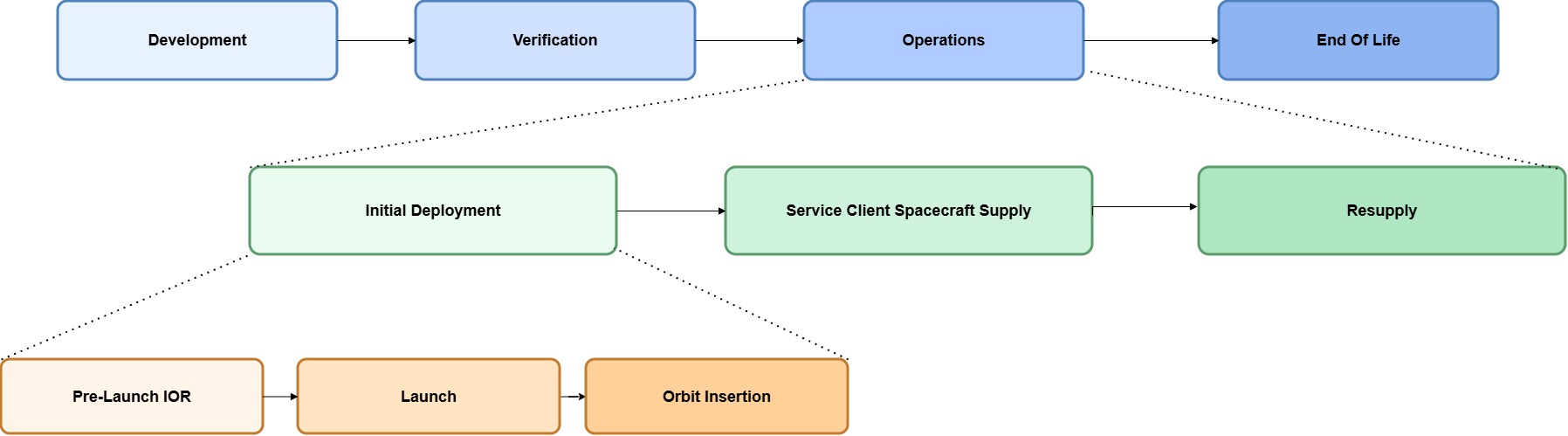
This section outlines the IOR Lifecyle Stages. Each stage can have several sub-stages.
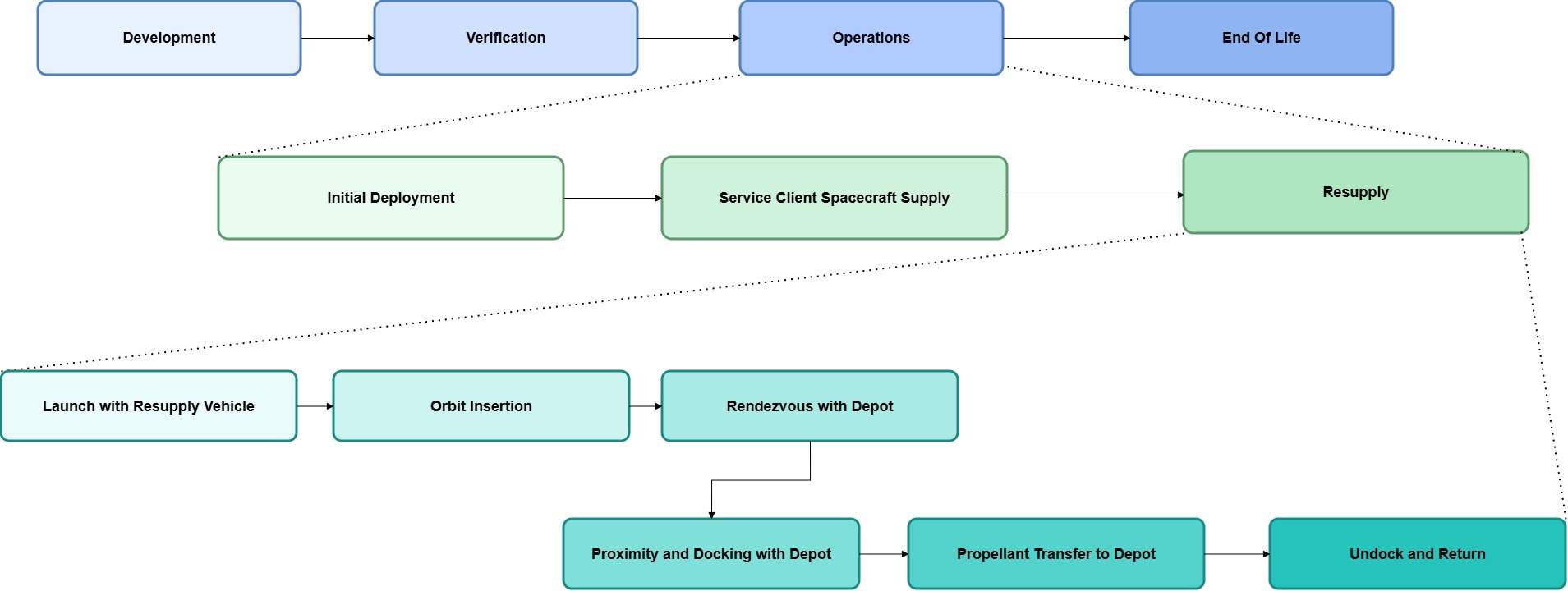
- Development
- Verification
- Operations – 3 sub-stages
- Initial Deployment
- Service Client Spacecraft
- Resupply
- End of Life – At end of life, the IOR system shall execute disposal or deorbit maneuvers in compliance with debris mitigation standards.

IOR Operations – 3 sub-stages
IOR Initial Deployment Stages
- Pre-Launch IOR: Launch Planning & Preparation
- Launch
- Orbit Insertion
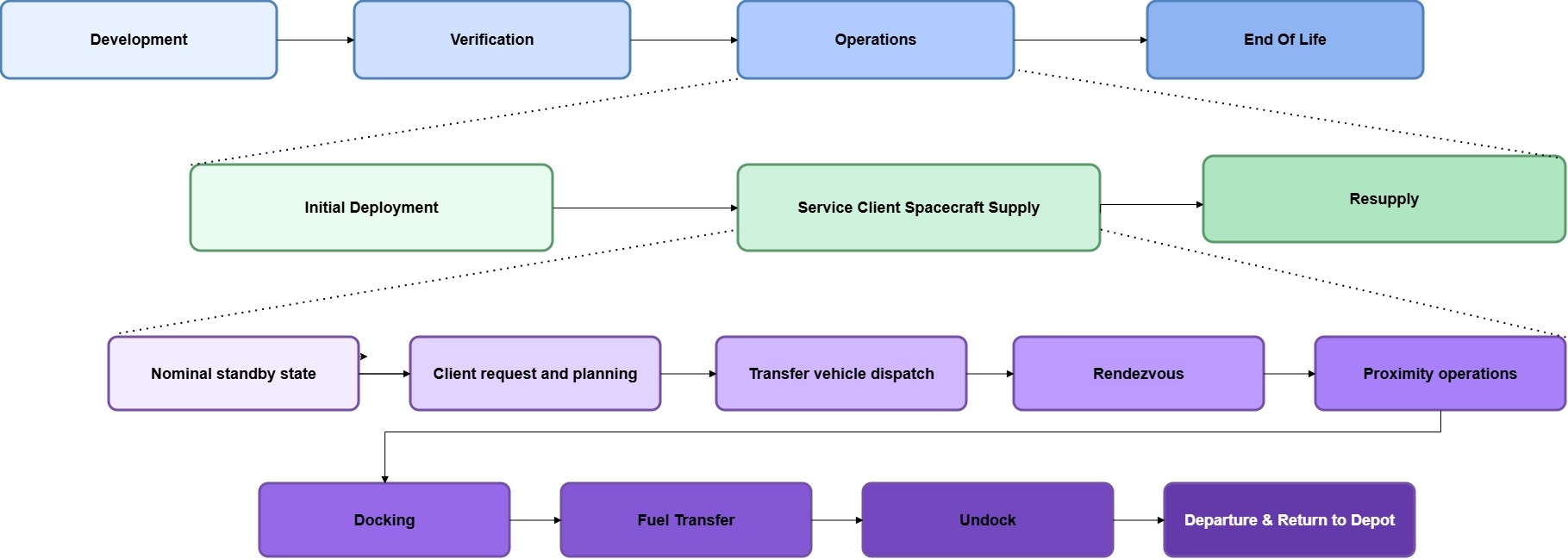
IOR Service Client Supply Stages
- Nominal standby state
- Client request and planning
- Transfer vehicle dispatch (if applicable)
- Rendezvous
- Proximity operations
- Docking
- Fuel Transfer
- Undock
- Departure & Return to Depot
IOR Resupply Stages
- Launch with Resupply Vehicle
- Orbit Insertion Resupply Vehicle
- Rendezvous with Depot
- Proximity Operations and Docking
- Propellant Transfer to Depot
- Undock and return
(Details are to be completed)
Operations CONOPS: Propellant Supply and Return
This CONOPS is inspired by CONFERS and IRIS/IRSIS RPOD CONOPS (see References).
It has been adapted for IOR architecture and supported servicing modes.
Scenario
- Nominal
- Orbit: LEO
- Client Spacecraft: IOR-Enabled (transfer-compatible interface, Not IOR Aware, or IOR Cooperative)
- RPOD: Guided (ground-supported, not autonomous)
Stage Description, Control Authority, and Operational Notes
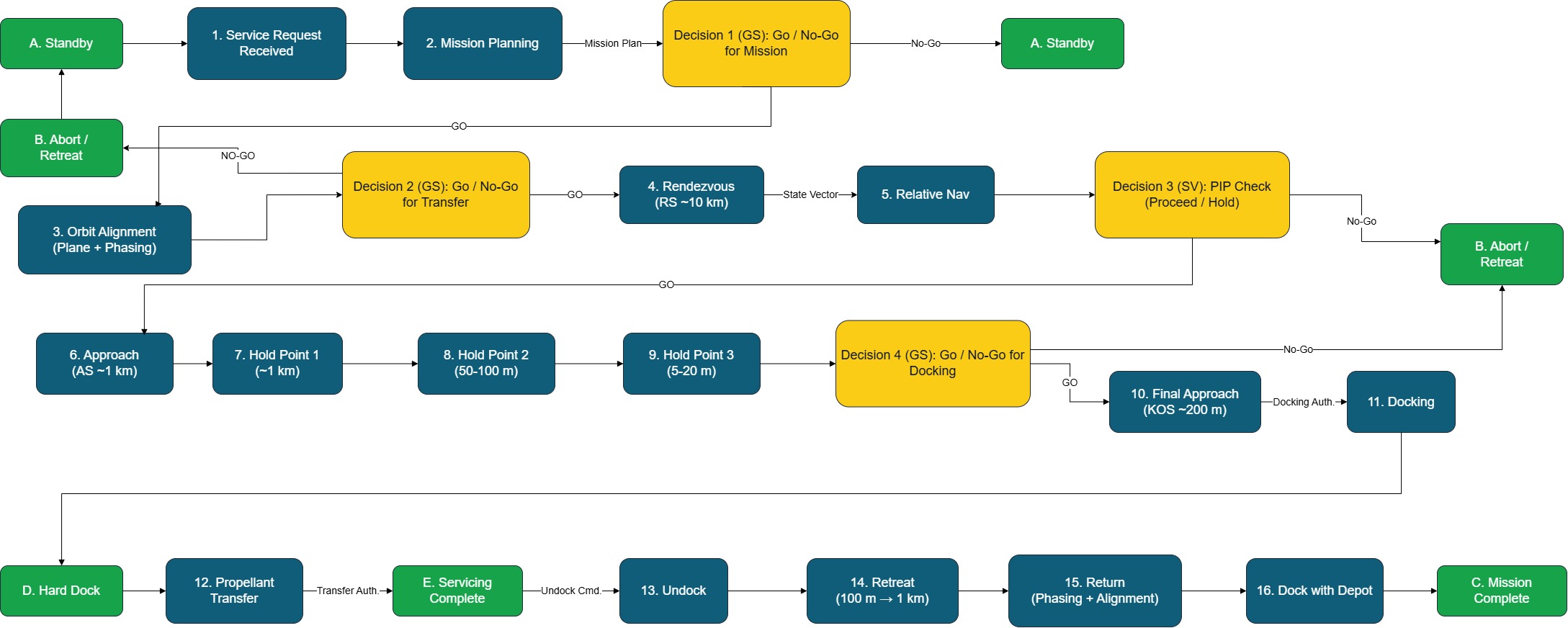
- Service Request Received – Client request received by GS and passed to IOR Mission.
- Mission Planning – GS develops mission plan including trajectory, ΔV, constraints, and decision gates.
- Orbit Alignment (Plane + Phasing) – SV performs maneuvers to align orbital plane and phase with CS and transfer toward RS.
- Rendezvous (RS ~10 km) SV enters Rendezvous Sphere and performs burns to approach AS under GS guidance.
- Relative Navigation – SV establishes relative navigation with CS and provides state updates to GS. Control: GS, authorizes proceed / hold / abort. SV performs on board relative navigation, maneuvering, and safety enforcement.
- Approach (AS ~1 km) – Transition from absolute to relative motion within Approach Sphere. Control: SV primary for guidance, navigation and control; GS supervisory (hold / abort authority)
- Hold Point 1 (~1 km) Stabilization and verification prior to continued approach.
- Hold Point 2 (50–100 m) Intermediate hold for validation of navigation, control, and safety constraints.
- Hold Point 3 (5–20 m) Pre-docking hold for final alignment and system readiness.
- Final Approach (KOS ~200 m) Controlled approach within Keep-Out Sphere and docking corridor. Control: Full onboard autonomy. GS monitoring only; no real-time control.
- Docking – SV mates with CS.
- Propellant Transfer – Transfer of planned propellant from SV to CS.
- Undock – SV separates from CS.
- Retreat (100 m → 1 km) – SV moves to safe separation and exits proximity regime.
- Return (Phasing + Alignment) – SV performs maneuvers to return to Depot orbit under GS guidance. Control: GS primary; SV executes with onboard navigation and safety enforcement.
- Dock with Depot – SV docks with Depot and returns to nominal configuration. Control:SV primary; Depot provides coordination and interface support.
State Description
A. Standby
Nominal state where Depot and SV are docked and maintaining service orbit.
B. Abort / Retreat
Safe disengagement and retreat sequence initiated after Go/No-Go failure.
C. Mission Complete
SV successfully returns and system is restored to Standby.
D. Hard Dock
SV and CS are mechanically secured and ready for transfer.
E. Servicing Complete
Planned propellant transfer to CS is completed and verified.
Propellant Delivery Mission Planning
Mission planning is performed by GS with input from Client Operator.
- Plane alignment with Client Spacecraft
- Transfer to Rendezvous Sphere (RS)
- Go/No-Go decision gate
- Transfer from RS to Approach Sphere (AS)
- Go/No-Go decision gate
- Transfer from AS to Keep-Out Sphere (KOS)
- Go/No-Go decision gate
- Determination of approach corridor
- PIP – Proximity Initiation Point definition
- Go/No-Go for proximity entry
- Proximity operations and docking sequence
- Return-to-Depot trajectory planning
Operations CONOPS: Propellant Transfer
This CONOPS is used from CONFERS CONOPS as it is (see References).
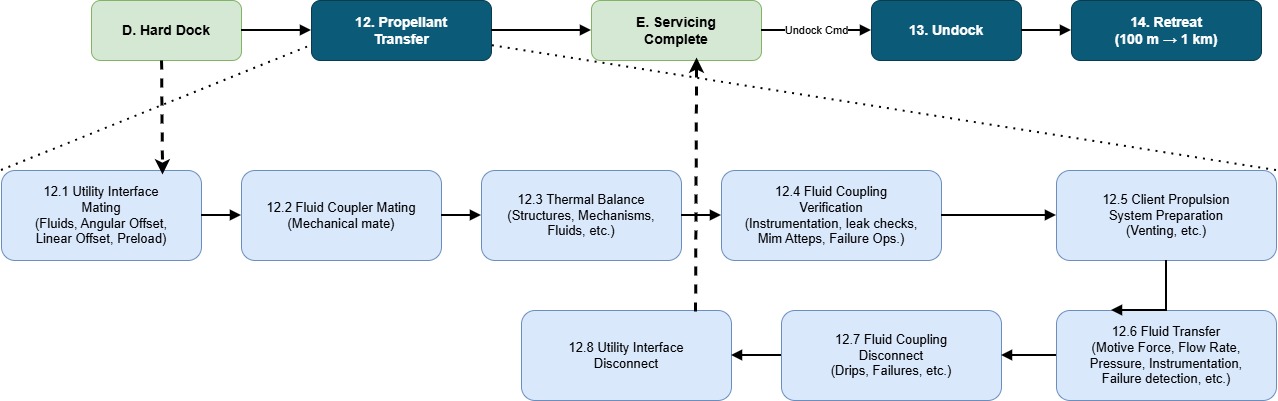
12. Propellant Transfer – Decomposed ConOps (Adapted from CONFERS)
12.1 Utility Interface Mating
Align and engage the servicer utility interface with the client interface to position the fluid coupler and apply required preload prior to coupling.
12.2 Fluid Coupler Mating
Mechanically mate the fluid coupler to establish a physical transfer path between servicer and client.
12.3 Thermal Balance
Verify that fluid transfer system temperature differentials are within allowable limits for the propellant prior to transfer or venting.
12.4 Fluid Coupling Verification
Validate seal integrity of the coupled system with leakage ≤ allowable limits.
If limits exceeded, perform disconnect–reconnect and re-test.
12.5 Client Propulsion System Preparation
Prepare client propulsion system for transfer (e.g., venting, line conditioning, configuration).
12.6 Fluid Transfer
Execute propellant transfer while monitoring flow rate, pressure, and system integrity.
Maintain leakage within allowable limits during transfer.
12.7 Fluid Coupling Disconnect
Terminate transfer and disengage fluid coupler, managing residuals and preventing leakage.
12.8 Utility Interface Disconnect
Disengage utility interface and return both systems to post-transfer safe configuration.
Detailed OPCON: IOR Initial Deployment
OpCon Stage: Pre-Launch IOR: Launch Planning & Preparation
Objective of the phase: Plan and authorize deployment of one or more IOR systems to the designated Service Orbit (SO).
Input:
- Flight-ready, verified IOR system
- Approved customer service contract
Trigger:
- Authorization for Trial Setup
- Executed customer service agreement
Key activities:
- Determine optimal Service Orbit (SO)
- Determine launch window and insertion analysis
- Coordinate all Actors including GS, Depot (D), SV, CV and Launch Vehicle (LV) Interfaces
- Confirm launch provider and mission integration readiness.
- Determine other customer service requirements
- Pre-Transport Testing
- Transport of Depot and SV to Launch Site (LS)
Key constraints:
- As presented in customer requirements
Exit condition:
- Completion of Launch Plan and supporting Logistics
Major risks or failure branches:
- Availability of Launch Vehicle
OpCon Stage: Launch and Orbit Insertion
Objective of the phase: Deploy IOR Depot/SV along with fuel to Service Orbit (SO) based on planning in Pre-Launch stage
Trigger:
Completion of Pre-Launch stage
Key activities:
Launch and Orbit Insertion.
($IAI)
Key constraints:
- Launch vehicle interface constraints
- Launch provider safety requirements
Exit condition:
- Launch of IOR in the Service Orbit
- Communication established between Depot and GS.
Major risks or failure branches:
- Depot’s orbit is not the planned Service Orbit
- Depot does not communicate with GS
Detailed OPCON: IOR Client Servicing
OpCon Stage: Nominal standby state
Objective of the phase: This is stage between two refuel service requests.
Trigger:
- Completion of Launch & Orbit Insertion
- Completion of a refuel request.
Inputs (from):
- GS Commands (GS/Control)
- Conjunction data (GS/data)
- Inventory Status (Built in)
- SV Health (SV) – power/thermal/battery
Key activities:
Depot:
- Maintains
a. Service orbit,
b. Propellant conditioning/pressure/thermal state
c. Communications
d. Inventory management
e. SV in healthy state enabling it to be woken up and provide service - Monitor conjunctions and executes avoidance when in standby
SV: SV remains in dormant deep-sleep mode while docked to Depot. The Depot provides survival power and wake-up command to wake SV. In the deep-sleep mode following are OFF:
· Communications
· Navigation sensors
· RPOD sensors
· GN&C
· Payload electronics
SV waits for command from Depot to wake up.
(Detailed subsystem configuration defined in System Requirements)
Output (to):
- Readiness state (GS)
- Inventory State (GS)
- Depot/SV Health (GS)
- Depot’s Telemetry (including state vector / ephemeris data – ECI) (GS)
Key constraints:
The depot as properties of a spacecraft hence Standard spacecraft operational constraints apply.
- Maintain orbit
- Collision avoidance
- Power maintenance
- Communications availability with GS
- Maintain proper spacecraft conditions
Exit condition:
- Request to Service (Propellant Amount, Interface Type, State vector (ECI) of the CV) – (GS/Control)
Major risks or failure branches:
- Loss of communication with GS – Trigger: Autonomous Safe Mode + GS reacquisition
- Collision Alert – Triggers: Collision Avoidance procedure
- Loss of Power: ($IAI)
OpCon Stage: Client request and planning
Objective of the phase: To plan the mission for delivery.
Trigger: Customer request to refuel. Customer Request to Refuel (GS) includes: CV ID, Orbit state vector Ephemeris (ECI), Planned service window, Refuel quantity, Interface type
Key activities:
Create a plan to deliver fuel. The input required to enable key activities: CV information including Kepler coordinates and fuel quantity (local). The plan covers all delivery stages:
- Determination of success: Before embark on plan, confirm that end-to-end requirements are met
a. ΔV margin sufficient
i. Required ΔV to reach PIP
ii. Required ΔV to abort + retreat
iii. Required ΔV to return to depot
b. Inventory sufficient
- Depot post-mission inventory ≥ Minimum Reserve Level
- Minimum Reserve Level is sufficient to sustain depot until next scheduled resupply window
c. Conjunction risk managed per Safety Policies.
d. Operational window feasible
e. Abort feasibility validated
- Plan for Rendezvous – how will the SV align with the CV (Client Vehicle)
- Proximity Operations
- Docking
- Refueling
- Undocking
- Departure
- Return to base
Key constraints:
- Can the CV be serviced?
- Propellant supply?
- Range safety / keep-out zones
- Max range/time for SV sortie
Output (to):
- Trajectory plan, timeline, ΔV budget, hold points, abort points (SV)
- Return Info – Return Trajectory plan, ΔV budget (GS) (SV)
- Go/No-Go decision (Depot/SV)
Exit condition (what ends it):
- Mission Plan Approved (Go)
- Mission Plan Rejected (No-Go)
Major risks or failure branches:
- CV not cooperative or wrong attitude
- Ephemeris uncertainty too high
- Conjunction probability unacceptable during approach window
- SV ΔV margin insufficient
- Docking port conflict / SV unavailable
- Propellant inventory insufficient
- GS comm coverage insufficient for docking/transfer
OpCon Stage: Rendezvous
Objective of the phase: Navigate the SV such as to place the CV so that proximity conditions are created and the proximity operations can initiate. This stage covers the SV in action. The Depot continues to execute nominal stage activities with the knowledge the SV is space bound as it left for Rendezvous.
Input (from):
- Parameter to initiate and complete Rendezvous (GS/Data)
a. CV Ephemeris data (PVT)
b. Trajectory path for SV
c. PIP thresholds - Authority to start proximity operations (GS/Control)
- Collison Avoidance
a. Conjunction assessment results: Pc_external + TCA + miss distance + object ID (GS/Data)
b. Proceed / Hold / Abort (GS/Control)
Trigger: Successful completion of Client request and planning phase
Key activities:
SV Activities:
- Using Navigation and Control Maneuver the SV to align the SV with CV.
a. Achieves Proximity Initiation Point
i. Relative position ( Δr < X km )
ii. Relative velocity (Δv < Y - m/s)
iii. SV has FOV (Field of View) to accurately identify and dock with CV.
iv. Valid sensor geometry and lighting conditions (for vision) - Maintain safety protocols to avoid collisions. Conjunction management executed per Cross-Cutting Operational Safety Policies.
- SV performs Go / No-Go Decision Gate
a. Verify PIP thresholds satisfied
b. Verify propellant margin sufficient
c. Verify comm link nominal
d. Verify abort trajectory valid
e. Relative navigation uncertainty shall be within defined bounds sufficient to guarantee safe abort capability and prevent keep-out zone violation
i. Relative navigation uncertainty within allowable bounds
ii. State estimate confidence level ≥ required threshold
Note: Δr, Δv are in LVLH frame
Threshold values defined in corresponding System Requirements.
Defined bounds as defined in the Mission Plan and corresponding System Requirements.
Key constraints:
- Valid maximum time for rendezvous
- Valid relative navigation solution available
- Ephemeris uncertainty within acceptable bounds
- Valid sensor geometry and lighting conditions (for vision)
- Relative position/velocity within thresholds
- SV must be placed such that Proximity operations can be carried out
a. Relative position & velocity as per PIP thresholds
b. The SV faces CV to start Proximity operations
Output (to):
· Go/no decision (GS/Control)
· SV’s State Vector Emphemeris data – ECI (to enable GS to monitor Rendezvous process (GS/Data)
Exit condition:
All these conditions have to be met to exit this stage:
- Verify PIP thresholds satisfied (go/no-go)
- Proximity Operations authorized
Major risks or failure branches:
- Collision between SV and CV
- SV is not able to be maneuvered to reach stage to continue with Proximity operations
- Loss of comm
- PIP tests failed
CV Ephemeris data: Ephemeris State Vector – ECI (GS/Data)
OpCon Stage: Proximity operations
Objective of the phase: To bring the SV to Docking stage. As in previous stage This stage covers the SV in action. The Depot continues to execute nominal stage activities with the knowledge the SV is space bound as SV had left for Rendezvous.
Input (from):
- CV Ephemeris data (GS/Data)
- Conjunction data (GS/Data)
Trigger:
PIP achieved and Proximity Ops authorized
Key activities:
- Proximity Initiation Phase
a. Transition from absolute orbit to relative orbit
b. Phasing burns to match orbital plane, altitude, mean motion
c. Drift control to reach approach corridor
d. Initialize relative navigation solution
e. Approach to first formal hold point ( < 1 kms) - Proximity Operations (Prox-Ops) – Detailed procedures defined in Phase 2 design documentation.
Abort trajectory maintained and validated throughout proximity operations.
Key constraints:
- Maintain safe separation and compliance with defined approach corridor and keep-out zone constraints.
Output (to):
Exit condition:
SV ready to dock to CV
Major risks or failure branches:
- SV lost CV from its FOV
- SV could not achieve pre-docking position relative to CV
Nominal IOR Servicing Mission Flow
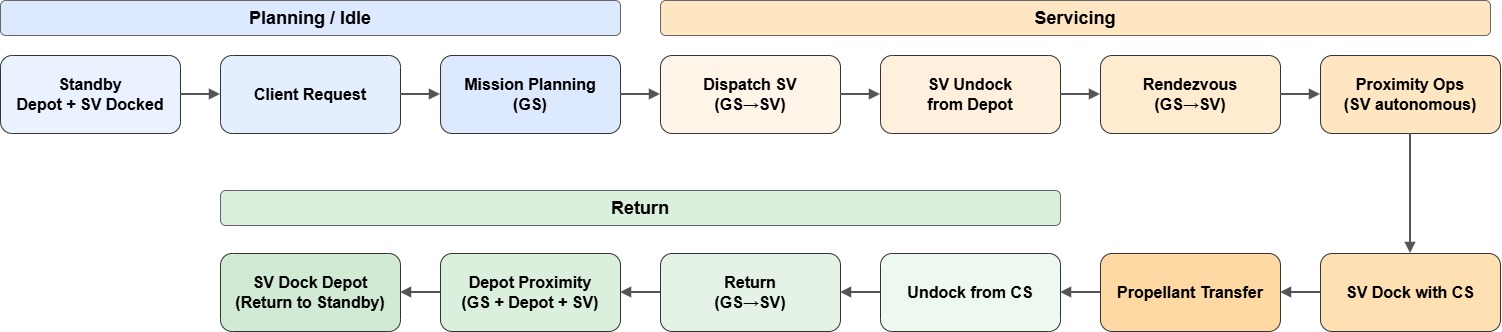
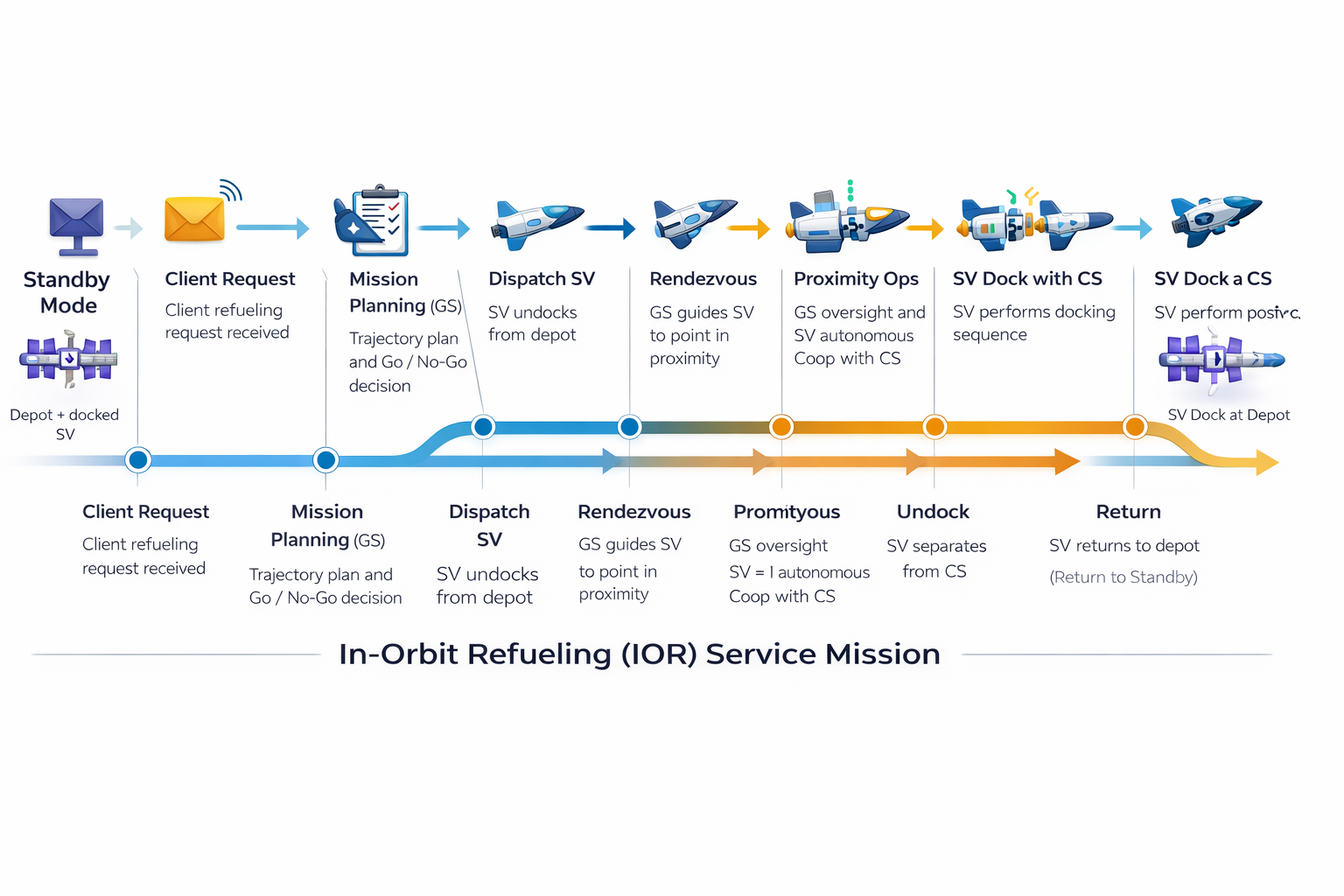
Operational Scenarios
Operational Scenarios outlined are below:
- Nominal Service
- Phasing Stage
- Nominal Proximity
- Proximity Abort / Retreat (TBD)
- Nominal Return to Depot
Operational Scenario: Nominal Service Scenario
Description: Flow showing a nominal pass case for a client service request for propellant delivery to be fulfilled.
Trigger: Client Operator submits a refueling request to the IOR Mission, including Client Spacecraft ID, propellant type, and quantity.
Actors Participating
- Client Operator
- IOR Mission
- Ground Station
- Service Vehicle (SV)
- Client Spacecraft (CS)
- Depot
Flow
- IOR Mission performs a pre-service check to confirm the service can be fulfilled.
- IOR Mission acknowledges the Client Operator that the service can be fulfilled and provides mission details.
- Client Operator authorizes the IOR Mission to initiate the service delivery.
- IOR Mission performs mission planning and trajectory design for the service operation.
- IOR Mission initiates the Orbit Plane Alignment Phase between the Service Vehicle (SV) and the Client Spacecraft (CS).
- Ground Station sends maneuver commands to the Service Vehicle (SV) to accomplish the plane alignment stage. The stage completes when the SV and CS are in the same orbital plane.
- IOR Mission initiates the Phasing Phase between the Service Vehicle (SV) and the Client Spacecraft (CS).
- Ground Station sends maneuver commands to the Service Vehicle (SV) to accomplish the phasing stage.
- The Phasing Phase completes when the Service Vehicle (SV) reaches Hold Point 1, and Proximity Operations begin.
- Service Vehicle (SV initializes) relative navigation with the Client Spacecraft (CS).
- Service Vehicle (SV performs proximity operations to enter the docking corridor of the Client Spacecraft (CS).
- Service Vehicle (SV executes) docking operations with the Client Spacecraft (CS).
- IOR Mission verifies docking stability and authorizes propellant transfer.
- Service Vehicle (SV transfers the requested propellant to the Client Spacecraft (CS).
- Service Vehicle (SV undocks from the Client Spacecraft (CS) and initiates the Return-to-Depot sequence.
Exit: Service Vehicle (SV) successfully docks with the Depot.
Operational Scenario: Phasing Stage
Description: Flow showing a nominal pass case for the Service Vehicle (SV) to perform phase alignment with the Client Spacecraft (CS).
Trigger: Service Vehicle (SV) achieves plane alignment with the Client Spacecraft (CS).
Actors Participating
- Service Vehicle (SV)
- Ground Station (GS)
- IOR Mission
- Client Operator
- Client Spacecraft (CS)
Flow
- Ground Station (GS receives) ephemeris data for the Service Vehicle (SV) from the IOR Mission and ephemeris data for the Client Spacecraft (CS) from the Client Operator.
- Ground Station (GS determines) the maneuver requirements for the Phasing Stage based on the relative orbital geometry between the SV and CS.
- Ground Station (GS sends) maneuver commands to the Service Vehicle (SV) to initiate the phasing maneuvers.
- Service Vehicle (SV continuously transmits) updated ephemeris data to the Ground Station (GS).
- Ground Station (GS receives) updated ephemeris data for the Client Spacecraft (CS) from the Client Operator.
- Service Vehicle (SV continues) the commanded maneuvers until the SV reaches Hold Point 1 relative to the Client Spacecraft (CS), from which Proximity Operations can initiate.
- Service Vehicle (SV initiates) the Proximity Initiation Phase (PIP).
- Proximity Initiation Phase (PIP) thresholds are verified.
Exit: PIP thresholds are met.
Operational Scenario: Nominal Proximity Operations
Description: Flow showing a nominal pass case for Proximity Operations between the Service Vehicle (SV) and Client Spacecraft (CS).
Trigger: Proximity Initiation Phase (PIP) thresholds are met.
Actors Participating
- Service Vehicle (SV)
- Ground Station (GS)
- Client Spacecraft (CS)
Flow
- Service Vehicle (SV reports) readiness to begin Proximity Operations to the Ground Station (GS). The report includes proximity status and relative navigation data for the Client Spacecraft (CS).
- Ground Station (GS authorizes) the Service Vehicle (SV) to initiate Proximity Operations.
- Service Vehicle (SV monitors) for override or abort commands from the Ground Station (GS).
- Service Vehicle (SV autonomously executes) proximity guidance and navigation to approach the Client Spacecraft (CS).
- Service Vehicle (SV continuously transmits) proximity status and vehicle health data to the Ground Station (GS).
- Service Vehicle (SV maneuvers) to Hold Point 2 (50–100 meters) from the Client Spacecraft (CS) and stabilizes its relative position.
- Service Vehicle (SV reports) proximity status and relative navigation data to the Ground Station (GS).
- Ground Station (GS authorizes) continuation of Proximity Operations.
- Service Vehicle (SV maneuvers) to Hold Point 3 (5–20 meters) from the Client Spacecraft (CS).
- Service Vehicle (SV reports) readiness to begin Docking Operations, including proximity status and relative navigation data.
- Ground Station (GS authorizes) initiation of the Docking Procedure.
- Service Vehicle (SV executes) docking operations with the Client Spacecraft (CS).
- Service Vehicle (SV establishes) a successful dock with the Client Spacecraft (CS).
Exit: Service Vehicle (SV) successfully docks with the Client Spacecraft (CS).
Operational Scenario: Failure Scenario: Proximity Abort / Retreat
Description: Flow showing a failure case for Proximity Operations between the Service Vehicle (SV) and Client Spacecraft (CS). This covers any time of failure detected either by GS or SV or Client Spacecraft
Trigger: Proximity Initiation Phase (PIP) thresholds are met.
TBD
Operational Scenario: Nominal Return to Depot
Description: Flow showing a nominal pass case of return of the Service Vehicle (SV) to the Depot.
Trigger: Undocking from Client Spacecraft is complete
Actors Participating
- Service Vehicle (SV)
- Ground Station (GS)
- IOR Mission
- Depot
- Client Spacecraft (CS)
Flow
- Service Vehicle (SV performs) a separation retreat burn to move into a safe corridor (100–200 m) to prevent collision with the Client Spacecraft (CS).
- Service Vehicle (SV retreats) to a Safe Hold Point (~500 m to 1 km) from the Client Spacecraft (CS). This maneuver may be executed autonomously by the SV or guided by commands from the Ground Station (GS).
- Service Vehicle (SV transmits) confirmation to the Ground Station (GS) that the Safe Hold Point has been achieved, including ephemeris data.
- Ground Station (GS sends maneuver commands) to the Service Vehicle (SV) to depart the client orbit geometry and initiate transfer toward the Depot orbit.
- Ground Station (GS sends maneuver commands) to the Service Vehicle (SV) to perform orbit plane alignment with the Depot.
- Ground Station (GS sends maneuver commands) to the Service Vehicle (SV) to perform phasing with the Depot.
- The Phasing Stage completes when the Service Vehicle (SV) reaches the far-range hold point from the Depot, where Proximity Operations begin.
- Service Vehicle (SV), coordinated with the Depot, performs proximity operations to enter the docking corridor.
- Service Vehicle (SV), coordinated with the Depot, executes docking operations with the Depot.
Exit: The SV successfully docks with the depot.