
| Document/Purpose | Defines the operational environment of the IOR mission, identifies external actors, and describes how the system interacts with them.
Reference: https://arcadia-method.org/operational-analysis.html |
| Traceability (Upstream /Downstream) Documents | Upstream: Business / Mission Analysis Downstream: Operational Analysis, OPCON Stages, Stakeholder Needs |
| Status | DRAFT |
| Baseline Version/Date | Current Version | Not yet established | v0.1 |
| Last Updated | |
| Owner / Lead | Sanjay Chadha |
| Contributors | |
| Reviewers | |
| Scope/Out-Of-Scope | Scope: Operational context of the IOR mission including actors, environment, and interactions. Out-of-Scope: Internal system architecture or design details. |
Table of Contents
Mission Contexts
Domain Reality, Gap and Intent
Domain Reality
- Satellites are fuel-limited, not capability-limited
- No unified operational framework across vendors
- Resupply, servicing, and operations are not standardized
Gap
- No standard interfaces between:
- Client spacecraft ↔ Service vehicle
- Depot ↔ Resupply
- Ground ↔ multi-party operations
- No interoperable RPOD + servicing framework
- No multi-vendor coordination model
Intent
- Define standardized interfaces (technical + operational)
- Enable multi-vendor interoperability
- Establish end-to-end mission framework:
- Planning
- RPOD
- Transfer
- Resupply
- Enable independent development under one mission architecture
Mission Context 1: LEO with Interface Enabled Client Spacecraft
- Orbit regime: LEO
- Target customer LEO constellation operator
- Refueling architecture: Depot + Shuttle
- Propellant family: Electric
- Service Vehicle (SV): Passive, Cooperative with compliant interface.
- RPOD Operations: Guided (as opposed to Autonomous- See MOs)
- Frequency of service: Service frequency dependent on propellant logistics and operational turnaround
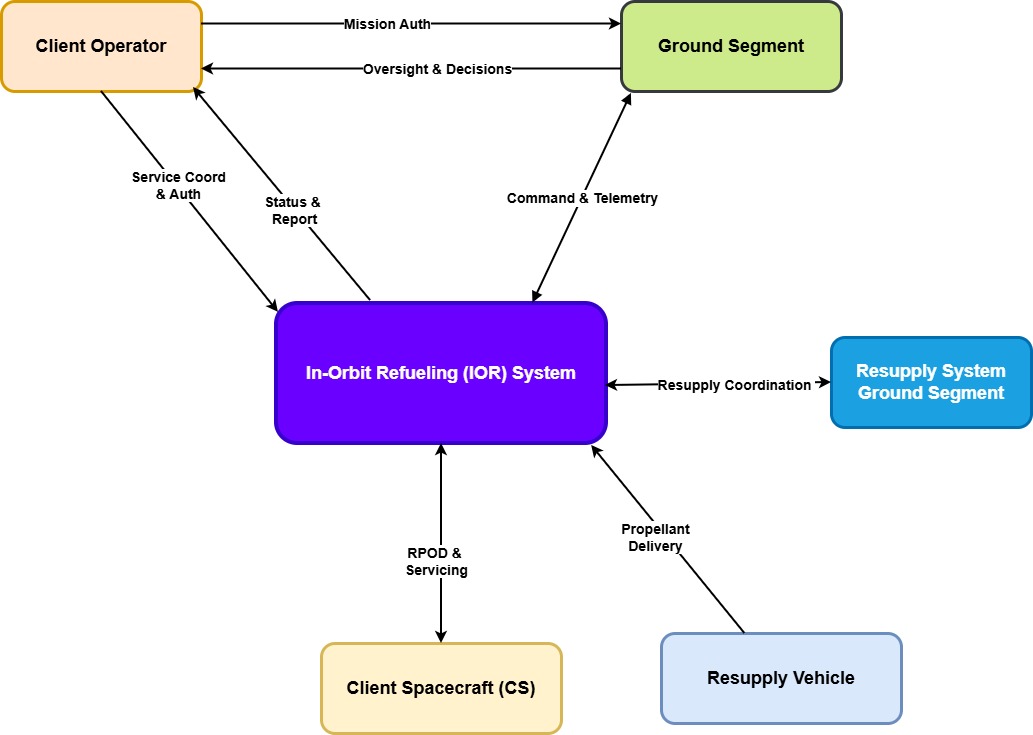
- Actors and Roles
- Ground Segment (GS) / Mission Ops
- In Orbit Refueling (IOR Systems Depot (D)/Service Vehicle (SV))
- Client Operator
- Client Spacecraft (CS) – Interface Enabled (Other supported: IOR Aware | IOR Cooperative from MO)
- Space Traffic Management inputs (catalog, conjunction warnings)
Market Context/Drivers
These are based on guesstimates and assumptions:
LEO constellation growth assumptions
With sovereignty becoming increasingly important for Europe, Canada, and U.S. defense initiatives (e.g., Golden Dome–type strategic resilience programs), combined with China’s pursuit of space capability expansion, the importance of LEO infrastructure is accelerating.
In parallel, the commercial success of Starlink and the competitive race involving Amazon’s LEO program have intensified large-scale constellation deployment.
Under current announced programs and growth trends, LEO satellites projected to be in space by 2030 could approach 100,000. This scale changes the LEO refueling economics.
Economic driver (cost of replacement vs refuel):
Constellation spacecraft are typically limited by onboard propellant rather than payload capability or structural degradation. Replacement remains expensive due to:
- Spacecraft manufacturing cost
- Launch and deployment cost
- Integration and commissioning effort
- Revenue disruption during transition
A cost-effective and reliable refueling capability becomes highly attractive to constellation owners. If refueling cost is significantly lower than replacement, it may:
- Extend operational life
- Improve capital efficiency
- Influence satellite architecture toward service-compatible designs
- Enable new lifecycle-driven business models
Competitive alternatives (replace, deorbit, life-extension via electric drift):
Replacement is expensive and would remain expensive until the time launch becomes inexpensive. Current alternatives include:
- Full satellite replacement
- Deorbit and redeploy
- Electric propulsion orbit optimization to stretch remaining propellant
- Overdesign with higher initial propellant margins
Replacement remains expensive, even as launch cost trends downward. Manufacturing and integration costs continue to represent substantial capital expenditure.
Refueling competes primarily against replacement economics and propellant overdesign strategies.
Regulatory environment (proximity ops constraints):
On-orbit proximity operations are subject to:
- Licensing and national space authority approvals
- Debris mitigation compliance
- Conjunction assessment and collision avoidance requirements
- Space traffic management coordination
Refueling operations must operate within these evolving regulatory constraints.
Debris environment considerations:
LEO is increasingly congested. Reuse of satellites through life extension can reduce:
- Launch frequency
- Deorbit/replacement cycles
- Additional debris generation from replacement turnover
However, servicing introduces temporary proximity risks that must be mitigated through robust operational design.