
Table of Contents
IOR Client satellite cooperation capability Levels
This initiative defines 4 level of cooperation capability levels for space crafts:
- Interface Enabled Satellite provides a compatible physical refueling interface allowing propellant transfer but does not actively participate in refueling operations.
- IOR Aware In addition to the physical interface, the satellite provides telemetry feedback to its ground system indicating refueling status and progress. IOR Aware must provide following controlled by Ground System:
- Delivers Realtime telemetry data
- Delivers RPOD status (including dock complete),
- Provide propellant levels in real time
- Perform attitude control
- Able to perform pitch roll and yaw on commands from the GS.
- IOR Cooperative – In this level the target assists the chaser in the RPOD operations, specifically the pre-docking, docking, undocking and post docking operations.
In this level satellite assists the chaser assisting proximity operations through local attitude alignment support. The satellite must be capable of performing these functions autonomously and locally:
- Local communication based on protocol defined by this initiative.
- Execute Perform pitch roll and yaw in cooperation with SV
- Perform attitude control
- Provide propellant status feedback
- IOR Capable – IOR capable spacecrafts are able to perform the IOR functionality as a chaser and fully cooperate with IOR capable as a target. Service Vehicle, Depot and Resupply Vehicle must be IOR capable. As a chaser the spacecraft leads the RPOD process as a master and as a a target spacecraft fully cooperates as a slave. This initiative defines how to IOR capable spacecrafts interact in a standard compliant manner.
Each IOR capability level is strictly defined. All features must be met to be classified at a given capability level.
Industry Terms, Definitions
- Fuel Shuttle – Shuttle that services the spacecraft. Also called Service Vehicle (SV)
- Fuel Station – A space craft which stores the fuel or propellant, also called Fuel Depot or Depot
- Fuel Depot – Same as Fuel Station also called Depot.
- Service Orbit (SO)– Orbit in which Depot & SV reside in nominal state. SO is selected for optimal delivery to SV.
- Service Vehicle – Same as Fuel Shuttle
- R-Bar Maneuvers for the service spacecraft (chaser) to meet the target by travelling along the radial vector (R-Bar), which points toward or away from the Earth’s centre.
- V-Bar Maneuvers for the service spacecraft (chaser) to meet the target by approaching along the velocity vector (V-Bar) of the target, i.e., moving from ahead of or behind the target along its direction of motion.
- Z-Bar Maneuvers Maneuvers for the service spacecraft (chaser) to meet the target by approaching orthogonally to the orbital plane (Z-Bar), i.e., along the cross-track direction normal to both the R-Bar and V-Bar.
RPOD Related Terms (Adapted from IRSIS/CONFERS)
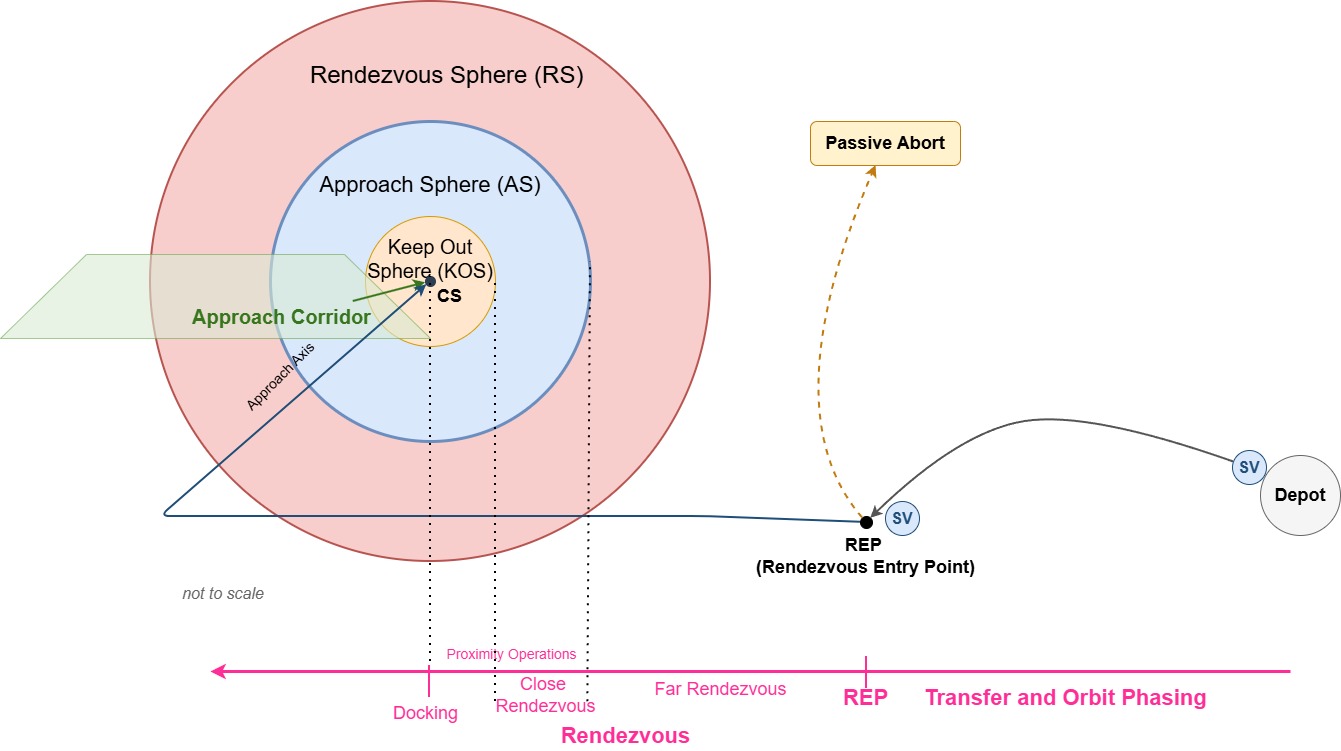
Terms adapted from International Rendezvous System Interoperability Standards (IRSIS) for IOR
- Operation Regions and Zones
- Rendezvous Sphere (RS) – Radius: 10 Kms around client space craft. Safe to abort in this region
- Approach Sphere (AS) – The AS is a 1 km radius sphere centered at the target vehicle center of mass.
- Keep-out Sphere (KOS) – The KOS is 200 meter radius sphere centered at the target vehicle center of mass.
- Approach/Departure Corridors – The Approach and Departure corridors are ±10° centered to the docking port axis within the KOS
- Abort (Passive Abort) – Safe trajectory ensuring collision avoidance without active control
- Approach Axis – The predefined relative line of approach from the chaser to the target used during final approach (e.g., along R-bar, V-bar, or docking port axis).
- Corridor – A bounded 3D operational region around the target within which specific RPOD maneuvers are permitted under defined constraints (relative position, velocity, and safety rules). The following corridors are defined by IRSIS
- Approach Corridor – Region within which the chaser is authorized to perform controlled approach toward the target.
- Departure Corridor – Region defining the safe path for retreat or departure away from the target.
- Relocation Corridor – Region used for lateral or orbital repositioning maneuvers around the target without initiating final approach or departure.
- Abort Corridor Predefined safe escape path the chaser follows upon abort to rapidly increase separation.
- Automatic Abort Corridor
- Manual Abort Corridor
- Mating Envelopes – The allowable relative position, orientation, and velocity limits within which mating (capture or docking) can safely occur.
- Capture Envelope – Broader tolerance limits within which initial contact or soft capture mechanisms can successfully engage prior to docking.
- Docking Envelop – Tight tolerance limits for relative position, attitude alignment, and closing velocity required for hard docking interface engagement.
- Visiting Vehicle – Also called Chaser in IOR is Service Vehicle.
- Transfer and Orbit Phasing – Transfer and Orbit Phase includes departure from Depot and reach to the start of Rendezvous. This phase in managed by IOR Operator team operates the mission along with real-time state vector of client space craft is received from the client operator. Transfer and Orbit Phasing aligns plane (i.e. RAAN), altitude and timing (phase angles), so the chaser arrives at Rendezvous Insertion (RI) with correct geometry.
- Target Phasing (TP) – Same as Transfer and Orbit Phasing
- Rendezvous Entry Point (REP) – Point in space when the Transfer and Orbit Phasing completes
- Rendezvous – This phase begins at REP when chaser/SV is in a co-orbital relative state with the client and transitions to relative navigation; ends at docking start.
- Far Rendezvous (FR) – FR navigation is managed by IOR operator via Ground Segment until the Approach Sphere is successfully achieved. This phase enables passively abort the approach on a trajectory that is operationally safe. This phase ends when reaching the Approach Sphere.
- Close Rendezvous Phase within the Approach Sphere (AS) where the service vehicle performs controlled relative motion operations including Approach and Fly-around, leading to final alignment and KOS entry
- Approach – This phase starts with a Go/No Go decision. A go decision triggers the Approach Initiation (AI) burn. The service vehicle transitions to the approach axis while in the Approach Sphere.
- Fly-around – Consists of a service vehicle maneuver during approach or departure in which the service vehicle transitions to another approach axis, or circumnavigates the target vehicle and returns to an approach axis.
- Keep-Out Sphere (KOS) – Protected zone; entry only via corridor
- Proximity Operations – All operations within Approach Sphere, including Approach and Fly-around, docking, undocking and departure/retreat. This phase includes Close Rendezvous phases above: Approach, Fly-around. These operations are performed in the Approach Sphere (AS) (used extensively within the NASA ISS community)
- Docking – Defined as the docking mechanism contact, capture and hard-mate. Docking begins at the time of initial contact of the vehicles’ docking mechanisms and concludes when hard-mating hooks/latches have been fully engaged. After first contact, rendezvous phase is complete. This phase is owned by the docking mechanism.
- Undocking – Defined as the physical separation of the two vehicles.
- Departure – For release and departure, the phase commences upon physical separation, either docking mechanism push-off or grapple release, from the target spacecraft (host platform). This phase is complete when the service vehicle is confirmed to be departing on a trajectory that is operationally safe and the visiting vehicle is outside the AS.
- Retreat – Defined as the service vehicle increasing its relative range with respect to the target client spacecraft, aiming at a predefined hold point.
- Hold – In this phase, the service vehicle maintains its relative position with respect to the target spacecraft such that it neither approaches nor retreats from the target.
- Free Drift – In this phase, the target client space craft’s and the visiting vehicle’s translational and rotational controls are inhibited. This phase is initiated at first contact for docking
- Abort – This phase is initiated automatically or by crew (chaser or target) for the service vehicle to perform a separation sequence (thruster firing), which places the service vehicle on a safe trajectory departing from the target.