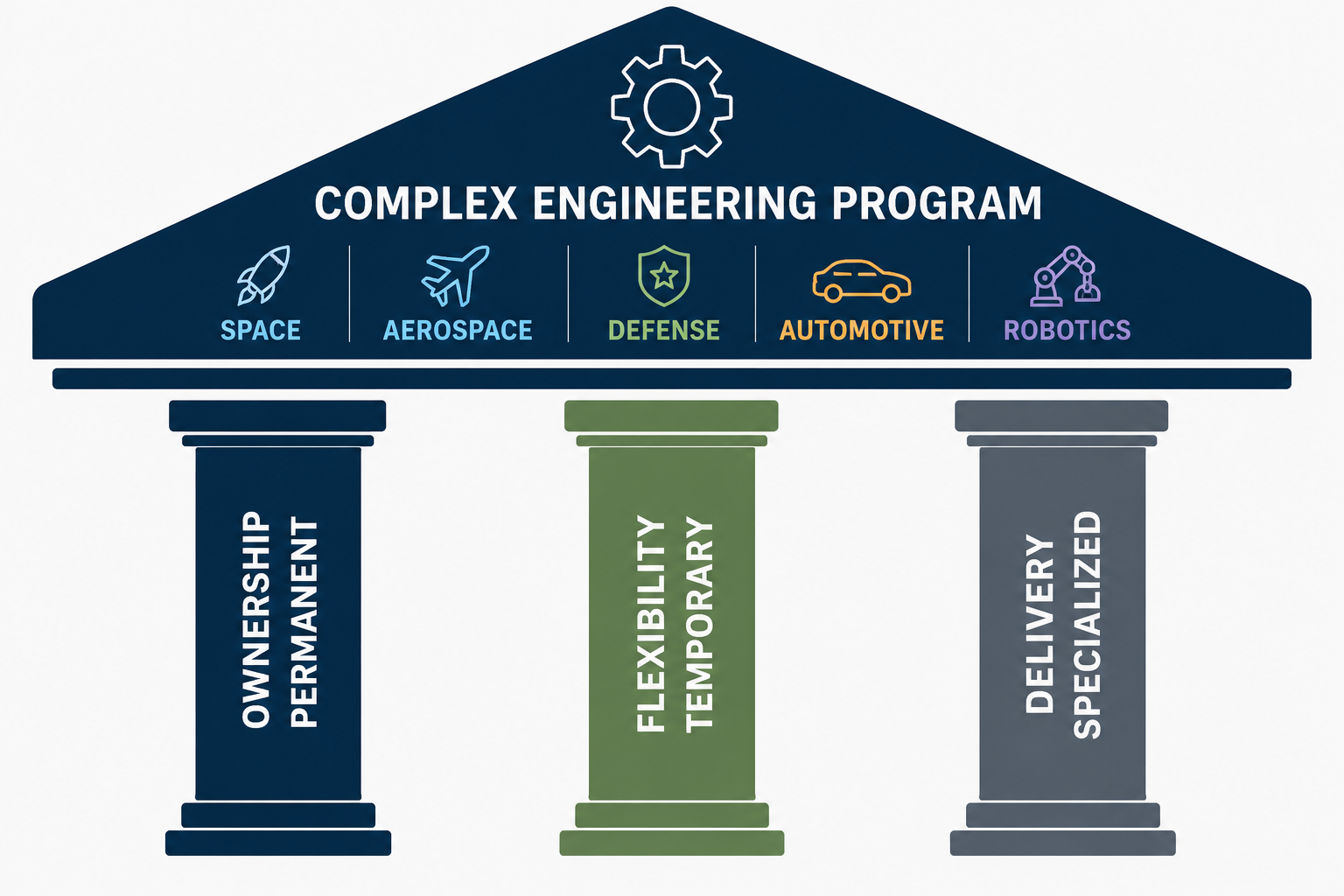
Modern engineering programs are increasingly complex, multi-disciplinary, and often span several years. As products evolve, organizations must continuously decide what work should remain internal, what can be performed by contractors, and when engineering partners become beneficial.
Making less-than-ideal decisions can increase costs, delay projects, and slow down progress.
Internal Teams
Internal teams are the glue from the start and remain the container of core IP knowledge and the continuity of institutional knowledge for the company. They are irreplaceable.
They hold:
- System knowledge
- Product architecture
- Long-term product vision
- Core development processes
- System-level thinking and decision-making
Complex projects often require many specialized skills over long durations. For this reason, core IP, system architecture, systems engineering processes, and product direction must remain with the internal team.
Internal teams should continue to own:
- Product strategy
- System architecture
- Core requirements
- Product evolution
- Critical technical decisions
However, many of these specialized skills are only required during specific phases of the project lifecycle.
When to Hire Contractors
Contractors are best suited for well-defined tasks where long-term continuity and deep system knowledge are not required.
They are particularly useful when:
- Project duration is uncertain
- Specialized skills are temporarily required
- Financial flexibility is preferred over full-time hiring
- Tasks are clearly scoped and isolated
Contractors can efficiently support execution, but they are generally not ideal for:
- Evolving system architectures
- Long-term ownership
- Integration-heavy activities
- Cross-functional coordination
When Engineering Services Become Important
Managing engineering teams and maintaining consistent, high-quality delivery requires significant management bandwidth.
In practice, one technical lead or manager is often required for every 7–8 engineers. Beyond this point, coordination complexity increases and delivery consistency can begin to decline.
Building and sustaining high-performing teams becomes particularly difficult when:
- Specialized skills are required
- Multiple disciplines must coordinate together
- Delivery timelines are aggressive
- Product complexity increases
This management constraint is often underestimated.
For this reason, engineering partners become increasingly important in complex product development environments.
Engineering services are most valuable when organizations:
- Lack sufficient management bandwidth
- Need delivery ownership for non-core but complex functionality
- Require structured execution across multiple teams
- Need external expertise without disrupting internal product focus
Engineering partners are not simply additional resources. They are expected to bring:
- Delivery structure
- Technical processes
- Coordination capability
- Systems engineering discipline
- Independent execution capability
What Services Are Ideal for Engineering Partners?
Proof-of-Concept (PoC) Development
Internal engineering teams are often fully occupied supporting existing customers, product releases, and revenue-generating activities.
At the same time, organizations continuously identify new market opportunities that require rapid demonstrations, prototypes, and technical evaluations.
These initiatives are often ideal for external engineering teams.
Engineering partners can:
- Take partially defined concepts
- Refine requirements collaboratively
- Develop PoCs with continuous alignment
- Deliver prototypes without disrupting internal delivery teams
This enables organizations to evaluate opportunities quickly while preserving focus on existing product commitments.
Independent Verification and Validation (IVV)
Internal teams may complete requirements development, traceability, architecture, and product implementation. However, an external engineering team experienced in continuous integration, verification frameworks, and validation processes can independently perform IVV activities.
In many programs, IVV is best performed externally to ensure:
- Independent assessment
- Objective validation
- Verification rigor
- Reduced confirmation bias
Legacy Product Support and Evolution
As organizations transition toward newer technologies and products, legacy systems still require long-term operational support.
External engineering teams can effectively maintain and evolve these systems while allowing internal teams to focus on next-generation product development.
This creates:
- Continuity for deployed products
- Reduced burden on core teams
- Better allocation of internal engineering resources
Customer and Operational Support
As products mature and deployments grow, senior architects and product designers are often pulled into operational support activities.
Over time, this reduces their ability to focus on:
- Product evolution
- System architecture
- Innovation
- Future roadmap development
An external engineering partner can be trained to manage operational support activities and customer interactions, allowing core internal teams to remain focused on strategic development.
The Real Challenge
The real challenge is not choosing between internal teams, contractors, or engineering partners.
The real challenge is choosing the right model for the right tasks and ensuring they work together as one system without unnecessary fragmentation, communication gaps, or integration issues.
A strong engineering partner that understands systems engineering principles and structured product development processes can significantly reduce these risks.
Engineering Support from ReliqAI
ReliqAI supports complex engineering programs through:
- Systems engineering and requirements traceability
- Embedded product development for new and existing systems
- Independent verification and validation (IVV)
This enables more structured and consistent delivery across complex, multi-team, and multi-vendor engineering environments.