Interoperability in space is not about working together within a single country. Space is a global domain and therefore requires coordination across organizations, companies, and countries.
What Does IOR Interoperability Look Like?
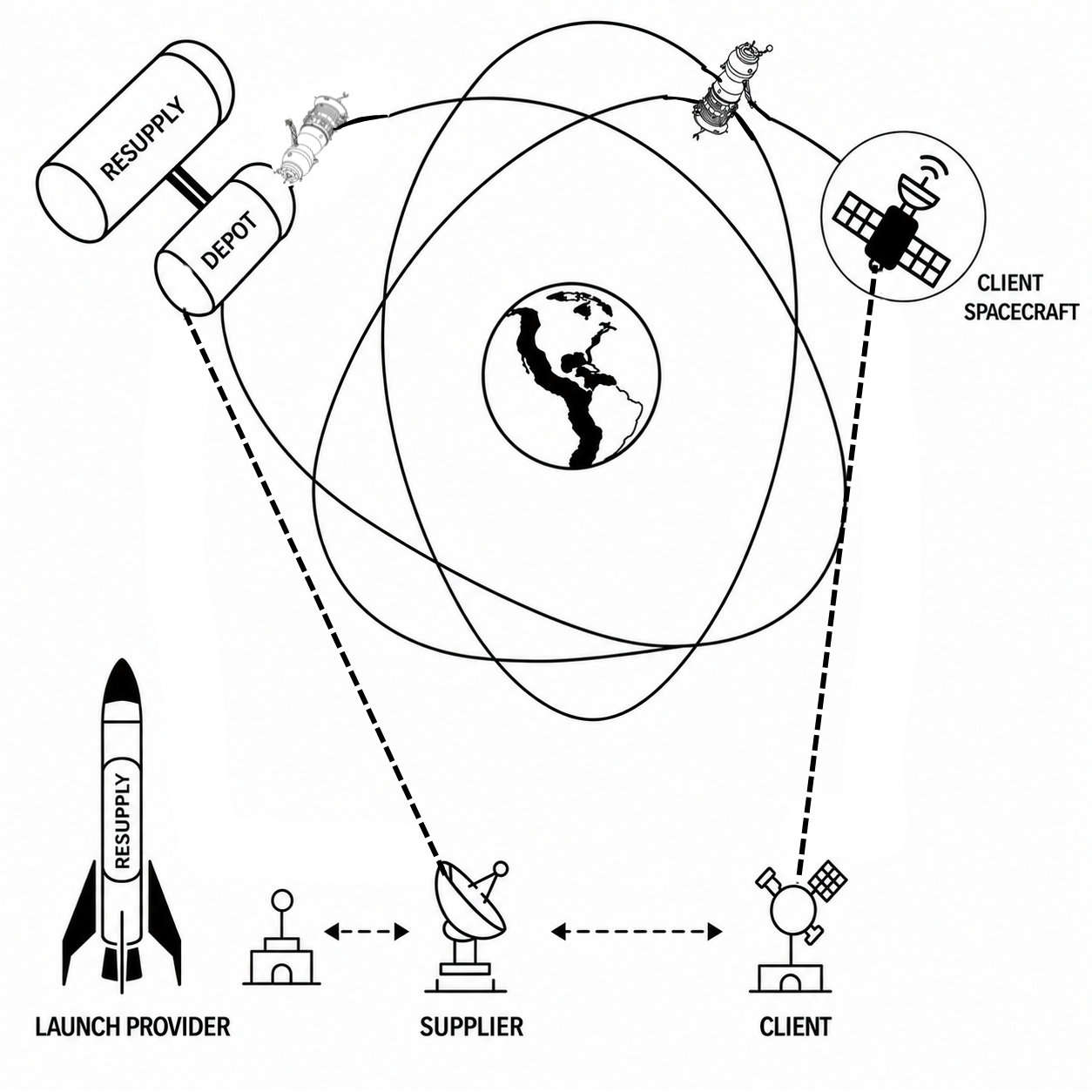
Figure 1: Closed IOR System
The best way to understand interoperability is to compare non-interoperable IOR systems with interoperable IOR systems.
| IOR Participant | Custom Non-Interoperable | Interoperable IOR | What Difference Does It Make |
| Economics | Cost: 24 Million / 100 kg Delivery: 20 months | Cost: 4 Million / 100 kg Delivery: 4 months | Faster and more cost-effective delivery |
| Resupply Propellant | Performed by the IOR system | Independent vendors take charge of refueling | Specialized vendors can cost-effectively refuel depots as they service thousands of depots |
| Depots | Interoperable depots that can be filled by multiple resupply providers | Vendors specialize in storage. Tens of vendors can deploy thousands of depots available and ready for supply | |
| Service Vehicle | Companies specialize in fulfilling propellant needs and identifying optimal depots for supply | Service vehicles specialize in RPOD and propellant transfer across different satellite types, sizes, propellant types, and Docking and Refueling Ports (DRPs). Their focus is servicing | |
| Client | Long-term committed, expensive, entrenched relationship | Places orders with suppliers as and when propellant is required | Short-term, transactional relationships based on past performance, KPIs, and cost |
The Economics of an Interoperable IOR Ecosystem
This section discusses the complete end-to-end cost of an IOR refueling project, comparing custom and interoperable systems. The figures below are intended to illustrate relative economics rather than absolute mission costs (in million USD).
Cost: 24M vs 4M (1/6th) Time: 20 Months vs 4 Months (1/5th) Flexibility: 10x
Interoperability is an economically compelling choice and should be recognized, supported, and adopted by propellant clients.
| Activity | Custom IOR Delivery Vendor | Vendor Part of Interoperable IOR System | ||
| Cost | Time Period | Cost | Time Period | |
| RFP creation and supplier selection | $1M | 5 Months | $0.2M | 6 Weeks |
| Planning | $1.5M | 3 Months | $0.2M | 2 Weeks |
| Ground Segment Integration with Supplier | $1.5M | 6 Months | $0.1M | 2 Weeks |
| Fuel Supply | $20M / 100 kg | 6 Months | $3.5M / 100 kg | 6 Weeks |
| Total | $24M | 20 Months | $4M | 4 Months |
Other Benefits
- Access to multiple suppliers
- Ability to switch suppliers based on performance
IOR Clients
IOR clients benefit the most from an interoperable IOR ecosystem. They save in project management costs, propellant costs, and delivery time while gaining greater flexibility through access to multiple service providers.
Once IOR clients recognize the benefits of interoperability, they have a strong incentive to support IOR initiatives and encourage interoperable solutions.
@spacewerks @esa @nasa @ISS
Recommendations
- Support and assist in the development of IOR processes, artifacts, and verification frameworks.
- Encourage vendors to participate in interoperability initiatives. Like fuel supply on Earth, IOR is ultimately a team effort. Long-term success depends on an ecosystem rather than individual proprietary solutions.
Service Providers
The IOR Interoperable ecosystem affects how service providers deliver services and what types of new service providers germinate. It is expected that service providers may be the most cautious participants in adopting interoperability.
Today’s service providers are focused on winning new business, participating in funded demonstrations and missions, and proving repeatable in-orbit refueling. IOR is a complex system-of-systems challenge, and capable teams are correctly focused on solving immediate technical, operational, and mission execution problems.
The long-term economics of interoperability can be difficult to prioritize while organizations are focused on demonstrations, missions, operational experience, and increasing the TRL of their technologies. Service providers should therefore continue executing their missions while keeping long-term interoperability in view.
Recommendations:
- Continue the heavy lifting of building practical and operational IOR systems.
- Understand and support IOR interoperability as the long-term direction for a scalable and sustainable ecosystem.
As service providers build experience and mature their capabilities, other technology providers can prepare to support interoperable IOR systems with specialized sub-components.
Technology Providers
Technology providers deliver technologies that enable the development of IOR subsystems. For interoperability to be achieved at a subsystem level, standardized interfaces of technology components reduce costs of building interoperable subsystems.
Technology providers have the potential to benefit the most from interoperability. If RPOD technologies and interfaces are compliant with standardized interfaces, spacecraft manufacturers will be more willing to integrate them, integration effort will be reduced, and deployment timelines can be shortened.
Lead interoperability. Companies that move early can benefit from larger market opportunities and potentially establish themselves as de facto technology providers. Compliance with interoperability standards can become a significant competitive advantage.
Do not wait until standards are fully established before engaging. Participate early, influence the standards, and position your technology accordingly.
Docking and Refueling Port (DRP)
The Docking and Refueling Port (DRP) is a key component of any interoperable IOR ecosystem. This section is intended for organizations developing proprietary docking and refueling ports.
@orbitfab (RAFTI), @northropgrumman (PRM), @dawnaerospace, @orbitfab (SIDRP)
The current tendency is to retain control of proprietary DRPs and charge for their use. This approach carries several risks:
- Slower adoption of IOR
- A fragmented ecosystem
- Higher integration costs
- Reduced willingness by spacecraft manufacturers to adopt the technology
History provides useful examples such as VHS versus Beta, Ethernet versus proprietary networking solutions, and USB versus proprietary connectors. Commercial adoption is often the most effective path to becoming a de facto standard.
Recommendation:
Take steps to position your DRP as a de facto standard.
Open your DRP to emerging IOR standards and encourage adoption across spacecraft, depots, stations, and other space infrastructure. The organization with the highest TRL, broadest adoption, and largest installed base will be well positioned to lead the market.
Ground Segment Vendors
Ground Segment plays a critical coordination role within the IOR ecosystem. As a result, ground segment vendors have some of the most significant interface challenges and also stand to benefit substantially from interoperability.
Interoperability within the IOR ecosystem will ultimately be realized through information exchange, making Ground Segment one of the most critical enablers of interoperability.
@GMV @Terma @Kratos @LeanSpace
Ground Segment to Ground Segment Interfaces
- Client to Supplier Ground Segments – Standardized information exchange supporting planning, scheduling, and execution of in-orbit refueling operations.
- Supplier to Resupply Ground Segments – Coordination of specialized propellant resupply operations to replenish depots.
- Depot to Service Vehicle Ground Segments – A future scenario where depots and service vehicles may belong to different organizations and require standardized coordination mechanisms.
Ground Segment to Spacecraft Interfaces
- Ground Segment to Client Spacecraft – Standardized information exchange supporting RPOD and in-orbit refueling operations.
- Ground Segment to Depot – Interfaces supporting depot coordination, RPOD participation, and operational activities.
- Ground Segment to Service Vehicle – Service vehicles may operate autonomously for extended periods, making coordination with ground systems more challenging.
- Ground Segment to Resupply Vehicle – Resupply vehicles transport propellant to one or more depots and may operate autonomously for significant portions of their missions, creating similar coordination challenges.
Recommendations for Ground Segment Vendors
- Early commitment to interoperability can provide Ground Segment vendors with a significant first-mover advantage.
- Ground Segment vendors should lead the definition of interfaces and information exchanges, as Ground Segment acts as the glue between organizations and carries much of the responsibility for enabling interoperability.
RPOD Technology Vendors
RPOD: @Jena-Optronik @obruta @Ommatidia LiDAR
RPOD technology providers and related subsystem vendors can benefit significantly from interoperability. Standardized interfaces provide several advantages:
- Reduced development and verification costs.
- Reduced sales cycle. Technologies that are proven, interoperable, and integration-ready require less sales support and integration effort.
- Greater focus on technology advancement rather than supporting numerous proprietary interfaces.
Recommendations for RPOD Technology Vendors
- Understand the complete RPOD CONOPS and deliver components that are ready for integration with AOCS, propulsion, communications, and other spacecraft subsystems.
- Take a leadership role in RPOD operational requirements, ICD development (including interfaces with OBCs and other subsystems), and IV&V artifacts.
Satellite, Spacecraft, and Space Station Manufacturers
@mdaspace @axiom
Satellites, spacecraft, and space stations are ultimately the recipients and beneficiaries of propellant delivery services.
Key Interfaces for Spacecraft Manufacturers
- Docking and Refueling Ports as part of client spacecraft, service vehicles, depots, and resupply vehicles.
- Spacecraft-to-spacecraft RPOD and propellant transfer coordination. Spacecraft may include client spacecraft, service vehicles, depots, and resupply vehicles.
- Service Vehicle coordination with Ground Segment.
- Depot coordination with Ground Segment.
The number and complexity of interfaces increase rapidly, which is where standardization provides significant value.
Recommendations for Spacecraft Manufacturers
- Focus on making spacecraft easy to refuel. Do not build a complete supporting IOR ecosystem solely to refuel your own spacecraft. Specialized providers exist for that purpose.
- Identify and integrate standardized Docking and Refueling Ports. Choose standardized approaches over proprietary approaches, even when end-to-end proprietary solutions appear attractive.
- Lead and participate in IOR standardization efforts. Spacecraft manufacturers are critical to the adoption and success of interoperability.
What does Interoperable IOR Look like
Different companies provide different parts of the IOR ecosystem.
- Resupply Vendors – Vendors who focus on launch coordination and delivering propellants to depots
- Depot/Storage Vendors – Vendors who provide storage of propellants in space in strategic locations (just like the gas stations). They coordinate with Resupply Vendors and Service providers
- Service Providers – Clients contact service providers to deliver propellants. Service providers identify optimal sources of propellant and deliver it to client spacecraft.
The Ground Segments and Spacecraft communicate with each other using the standardized interfaces they are built on.
Conclusion
On Earth, interoperability has repeatedly demonstrated its value. Examples include IP networking, 5G, fuel distribution networks, and logistics ecosystems. These industries have shown that interoperability reduces friction, lowers costs, increases competition, and accelerates adoption.
There is no reason why space should be different. Join the In‑Orbit Refueling Interoperability Group at inorbitrefueling.org
About ReliqAI
ReliqAI is an Ottawa-based engineering services firm focused on mission-critical systems. The company works with organizations in space, aerospace/defense, and complex embedded domains, supporting programs through MBSE-based systems engineering, traceability-driven QA and IV&V, and embedded engineering services.
About the Author
Sanjay Chadha is the Founder and Technical Director at ReliqAI. He writes based on hands-on experience with complex, long-lifecycle systems and system-level risk reduction.