Artificial intelligence is rapidly reshaping engineering workflows. Across many industries, it is narrowing the gap between experts and newcomers by making knowledge more accessible and structured.
But what does that mean for systems engineering?
AI Is Leveling Expertise across Industries
AI is increasingly narrowing the knowledge gap between seniors and juniors, between experienced and less experienced professionals — even between doctors and patients, and lawyers and their clients.
Access to information and explanations is no longer limited to specialists.
This naturally raises an uncomfortable question: Is AI now becoming the missing subject matter expert in systems engineering?
This article discusses ideal role of Systems Engineer and AI where each start and end.
The AI Knowledge Equalization Effect
AI tools are now accessible to almost everyone involved in engineering work. Engineers, students, domain specialists, and newcomers can all generate structured explanations, requirements drafts, or architectural ideas within seconds.
At first glance, this appears to level the knowledge gap across experience levels.
However, experience still plays a critical role.
Experienced engineers tend to ask better questions. They structure prompts more effectively, guide the interaction with the AI, and challenge the responses they receive. Subject matter expertise allows them to build chains of inquiry that refine the problem progressively.
In systems engineering, this matters greatly. AI can generate responses, but the value of those responses depends heavily on how the questions are framed and interpreted.
In other words, AI may broaden access to information, but expertise still guides how that information is used.
What Subject Matter Expertise Really Means in Systems Engineering
Subject matter expertise in systems engineering goes far beyond familiarity with processes or tools. It reflects accumulated experience with how real systems behave under constraints.
One of the most important roles of subject matter expertise is acting as a devil’s advocate when defining requirements and assumptions.
Experienced engineers challenge the initial framing of a problem, requirements and assumptions. They question whether requirements are realistic, whether assumptions are justified, and whether constraints have been properly understood.
For example, assumptions about traffic loads, operational demand, or system capacity are often overestimated. Systems may be designed for theoretical peaks rather than realistic mission conditions, leading to unnecessary complexity and over-engineering.
Subject matter expertise helps ground these assumptions in operational reality by asking questions such as:
- Are the requirements realistic given the operational context?
- Are we overestimating demand or traffic levels?
- Are timing constraints achievable within physical limits?
- Are the system boundaries correctly defined?
Assumptions propagate through the entire architecture; unrealistic assumptions lead to costly and overly complex system designs.
Where AI Is Powerful in Systems Engineering
While AI does not replace subject matter expertise, it can be extremely powerful in supporting parts of the systems engineering process.
- One of its strongest contributions is improving completeness. Systems engineering artifacts contain large amounts of structured information, and AI can help identify missing elements or incomplete sections.
- AI is also very useful for improving the language and clarity of engineering documents. It can help refine requirements wording, improve consistency across sections, and strengthen the readability of technical material.
- Traceability support is another area where AI can be valuable. Systems engineering requires maintaining relationships between mission objectives, system requirements, and architectural elements. AI can assist in highlighting missing traceability or inconsistencies across artifacts.
- AI can also guide engineers through structured engineering processes. Frameworks such as ARCADIA or model-based systems engineering approaches involve multiple viewpoints and decomposition steps. AI can help ensure these steps are not overlooked.
- Finally, AI can assist engineers in reviewing documents for completeness and process compliance. It can help highlight missing assumptions, incomplete sections, or structural inconsistencies.
In these areas, AI acts as a productivity multiplier.
Where AI Still Falls Short
Despite these advantages, an important boundary remains. AI can process large volumes of information and generate structured responses. But processing information is not engineering judgment.
In systems engineering, thinking means framing the problem, defining system boundaries, evaluating trade-offs, and deciding which architectural choices are acceptable.
The most effective use of AI is therefore not replacing thinking, but supporting it.
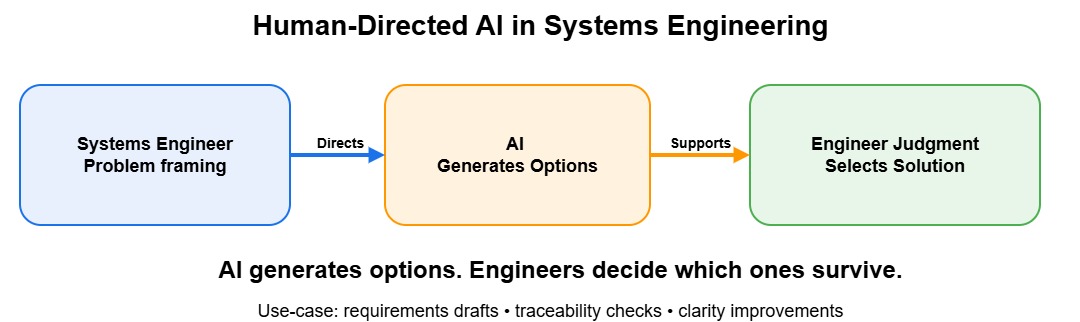
Engineers direct AI through the reasoning process. They guide the questions, challenge the responses, and determine which ideas are valid within the system context.
AI can generate options. Engineers decide which ones survive.
In complex domains such as space systems, architecture decisions often involve incomplete information, conflicting constraints, and mission-level consequences. These choices require judgment built from experience.
Governance: Where AI Stops and Engineering Accountability Begins
As AI becomes more integrated into engineering workflows, a governance question emerges.
Where should AI assistance stop, and where must engineering accountability remain human?
- Certain responsibilities must remain firmly with engineers. Engineers collect and analyze stakeholder inputs, translate those inputs into structured stakeholder requirements, and ensure that the resulting requirements reflect realistic mission objectives.
- Engineers approve requirements and define the architecture. They are responsible for the initial architectural decisions as well as the ongoing evolution of the system design.
- System decomposition, interface definition, and allocation of responsibilities across subsystems must also remain engineering responsibilities.
AI can support these activities, but it should not replace them.
AI should NOT be used to generate complete engineering documents or entire requirement sets without human reasoning behind them. When large blocks of text are produced automatically, there is a risk that the document appears complete while the underlying engineering thinking has not been validated.
AI can assist reviewers by identifying gaps and highlighting inconsistencies, but engineering reviews must remain accountable human activities.
Example: AI Supporting the In-Orbit Refueling (IOR) Initiative
A practical example of this can be seen in the In-Orbit Refueling (IOR) architectural initiative being developed at ReliqAI.
The project itself was conceived and structured by engineers. The mission context, architectural intent, and decomposition strategy were defined through engineering reasoning.
AI has been used extensively to support the documentation and engineering process. It assists with improving language clarity, checking completeness of sections, ensuring structural consistency, and supporting traceability across artifacts.
As the initiative progresses through its systems engineering phases — requirements definition, architectural decomposition, and traceability development — AI will continue to assist the engineers executing the work.
In this model, engineers guide the thinking, while AI accelerates the execution.
Conclusion: AI as an Amplifier, Not a Replacement
The rise of AI raises the question of whether it can replace subject matter expertise in systems engineering.
AI certainly narrows the knowledge gap and accelerates access to structured information. It can support documentation, traceability, and structured reasoning.
But subject matter expertise involves more than knowledge. It involves questioning assumptions, understanding constraints, anticipating system behavior, and making decisions under uncertainty.
| AI processes information and generates structured responses. Engineers direct the reasoning process.
AI generates options. Engineers decide which ones survive. |
In complex systems — such as space — engineering judgment remains central. The future of systems engineering is unlikely to be one where AI replaces engineers. It is likely to be one where experienced engineers use AI to extend the reach, speed, and effectiveness of their own expertise.