
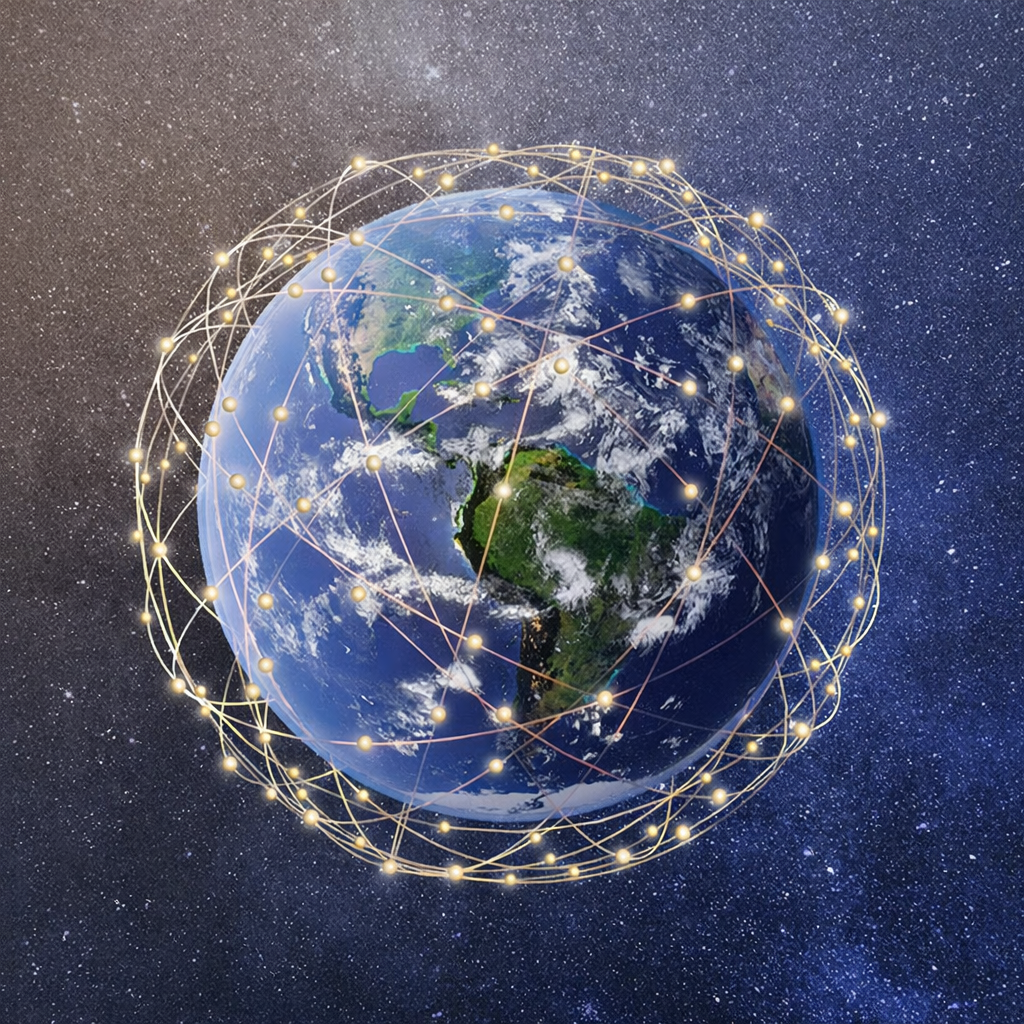
Problem Statement
LEO constellation design requires early validation of satellite visibility, landing station availability, and handover behavior.
Static coverage assumptions are insufficient to answer key planning questions related to gateway outages, handover strategies, and constellation sizing.
Critical questions to address:
- What is the impact of losing a landing station?
- What is the optimal number and geographic placement of landing stations?
- Which landing-station handover strategy is most effective (minimal handover, best-signal, make-before-break)?
- How do orbital parameters affect outages, latency, and resilience?
Problem Environment
- LEO satellite constellation
- Time-varying satellite trajectories
- Multiple geographically distributed landing stations
- Gateway-centric architecture
- Strong coupling between:
- Orbital height
- Inclination
- Satellite count
- Landing-station placement
- Handover strategy
Project Description and Delivery
An Orekit-based constellation simulation system was developed to model satellite orbits using Keplerian parameters and propagate trajectories over time.
The simulation computes:
- Satellite position and visibility
- Line-of-sight to landing stations
- Gateway availability and outages
- Handover opportunities between satellites and landing stations
This enables physics-based trade studies for constellation and ground-segment design.
Orekit-Based Constellation Simulation
The simulation framework supports evaluation of:
- Landing-station outage impact
- Optimal landing-station count and placement
- Landing-station handover strategies:
- Minimal (horizon-to-horizon)
- Best signal / best geometry
- Make-before-break
Simulation Scenario 1: Availability Analysis
Configuration
- Six satellites in a single orbital plane
- Four landing stations located in:
- Canada
- Europe
- Japan
Result & Outcome
- Maximum gateway outage of approximately 100 minutes
- During this period, no satellite had visibility to any landing station
- Demonstrates how constellation geometry can create extended gateway outages
- Highlights risks not visible through static coverage analysis
Questions Addressed
- What is the service impact of landing-station loss?
- How long and how frequent are gateway outages?
- Are landing stations optimally placed for the selected orbit?
- Should constellation parameters or ground infrastructure be adjusted?
Simulation Scenario 2
Constellation Optimization Trade Study
The simulation is extended to support optimization across:
- Orbital altitude (latency vs satellite count)
- Number of orbital planes
- Number of shells
- Number of satellites per orbit
- Landing-station placement and redundancy
- Satellite lifetime (drag and propellant consumption)