
Many startups may “do systems engineering.” They build requirements. They build architecture diagrams. They may even have someone with “Systems Engineer” in the title.
Yet when integration begins, things unravel. Interfaces drift. Requirements conflict. Verification becomes reactive. Architecture decisions are revisited under pressure. The problem is rarely that systems engineering is wrong.
More often, the organization is not structurally set up and does not have the discipline to support systems engineering. Here are a few reasons why internal Systems Engineering does not pan out in startups:
1. Systems Engineering Without Authority
In many startups, the SE role exists but does not carry decision power.
The systems engineer may document architecture, define interfaces, and identify risks. However, when delivery pressure increases, subsystem teams make local decisions that bypass architectural control.
Without authority to enforce interface discipline or reject misaligned changes, systems engineering becomes advisory. Advisory architecture does not hold under integration stress.
Internal staff may also struggle to obtain undivided attention and full empowerment from leadership. When the SE role is embedded within the same hierarchy that is driving feature delivery, escalation paths are often constrained.
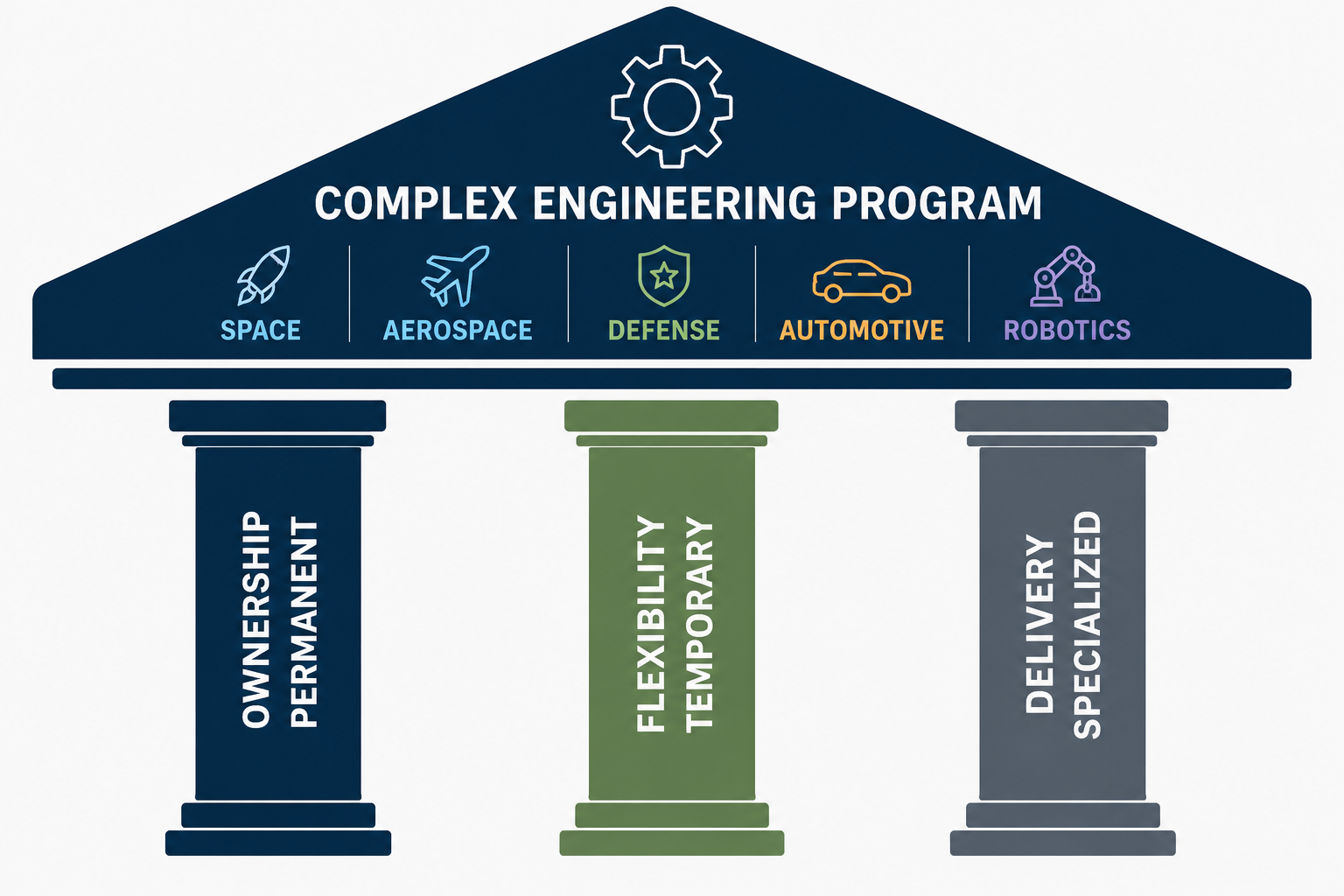
By contrast, external systems engineers are brought in with an explicit mandate. They request and require cross-functional access, and leadership tends to grant that empowerment because it is tied to a defined engagement.
Structure changes behavior.
2. Feature Velocity Over Architectural Discipline
Startups survive on speed. Demonstrations, customer milestones, and investor updates often drive short-term execution. In this environment, architectural consolidation feels like delay.
The result is subtle:
- Requirements are captured but not stabilized
- Interfaces are defined but not controlled
- Assumptions are documented but not validated
Integration debt accumulates and becomes visible only when subsystems must work together.
3. Budget and Schedule Misalignment
Systems engineering requires time in the schedule and allocation in the budget. In startups, funding typically prioritizes visible progress:
- Hardware prototypes
- Software features
- Payload capability
Systems engineering work — stakeholder alignment, scenario validation, failure analysis — is less visible.
If SE does not have protected time, it becomes reactive instead of preventive.
4. Lack of Domain Expertise
Domain expertise adds another layer of difficulty. In startups, the few individuals with deep domain knowledge are usually overloaded with operational or delivery tasks. Their expertise is consumed by immediate needs.
As a result, systems engineering proceeds without sufficient domain input.
An external systems engineer with domain expertise, when engaged properly, can be focused primarily on system-level coherence rather than day-to-day firefighting.
5. Cultural and Access Constraints
Startups often celebrate individual technical brilliance. This is not wrong. However, systems engineering depends on:
- Cross-functional alignment
- Trade-space negotiation
- Constraint discipline
- Controlled decision processes
If the culture favors local optimization over system coherence, architecture fragments.
Access also matters. Effective systems engineering requires direct engagement with users, operators, and stakeholders.
Internal SE roles do not always receive that direct access. They may be filtered through management layers or constrained by internal priorities.
External systems engineers, especially when engaged for architectural consolidation, often require and are granted direct access to users and operations.
That direct line reduces assumption drift.
6. The Real Issue
Systems engineering does not fail in startups. Startups often fail to structurally support systems engineering.
For internal systems engineering to deliver value, the organization must provide:
- Clear authority
• Protected budget and time
• Access to domain expertise
• Direct access to stakeholders and operations
• Decision ownership clarity
• Cultural respect for architectural discipline
Without these, even a capable systems engineer cannot prevent architectural drift. This seldom happens in startups.
Conclusion
Startups do not need less systems engineering. They need alignment between structure, authority, expertise, and expectations.
Otherwise, what appears to be systems engineering is documentation theatre — and documentation does not integrate systems.
Internal systems engineers often do not have the budget, authority, or time to properly support systems engineering. Hence, an external systems engineer can be a good option for startups.
About ReliqAI
ReliqAI is an Ottawa-based engineering services firm focused on mission-critical systems. The company works with organizations in space, aerospace/defense, and complex embedded domains, supporting programs through MBSE-based systems engineering, traceability-driven QA and IV&V, and embedded engineering services.
About the Author
Sanjay Chadha is the Founder and Technical Director at ReliqAI. He writes based on hands-on experience with complex, long-lifecycle systems and system-level risk reduction.